

LT HorizonLearning Technology HorizonFree newsletter
Horizon / Published assessment

Mediazoo’s AI Performance Gap Puts Human Judgement at the Centre of AI Readiness

Mediazoo Group’s whitepaper, reported by Learning News, frames weak returns from AI investment as a workforce capability problem rather than only a technology problem. Its central proposal is “AI cognitive readiness”: helping people judge when to question or trust AI, and change work processes when a better approach becomes possible. This is an early, vendor-linked signal, not evidence of product adoption or improved business outcomes.

Source published 2026-10-20 · LT Horizon published 2026-10-21 · Evidence checked 2026-10-21.

From access and skills to behaviour

The whitepaper describes three phases of AI transformation: access, skills and behaviour. It argues that organisations may have supplied tools and training without changing how people think, decide and act in daily work. [s0-1586]

Mediazoo defines its proposed third phase, AI cognitive readiness, as knowing when to question AI, when to trust it and when to alter a process because AI enables a better option. The concept therefore extends AI literacy into judgement and workflow redesign. [s0-1744]

The reported performance gap

Learning News reports that the paper uses PwC and McKinsey findings to describe a gap between AI capability and business performance. The cited figures say 56% of CEOs saw neither higher revenue nor lower costs from AI investment, while 12% saw both. [s0-799]

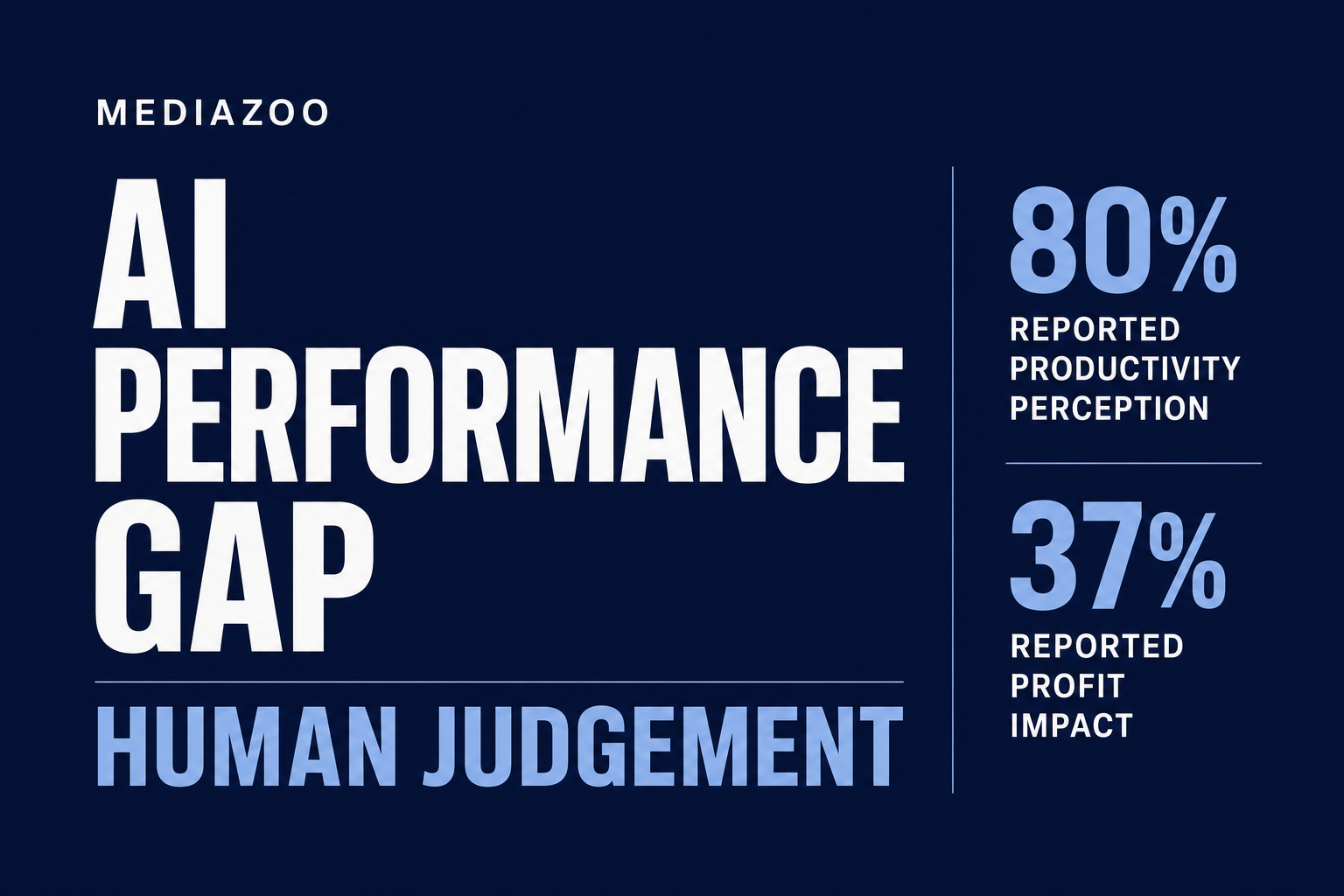
The same report says 80% of people surveyed by McKinsey felt AI had improved their productivity, but only 37% reported a profit impact, and 6% of organisations qualified as AI high performers. These figures are reported as supporting context for the whitepaper, not as an independent validation of Mediazoo’s diagnosis. [s0-957]

How uncertainty becomes a work habit

The paper draws on behavioural science from Uncertainty Experts, developed with scientists at UCL, to connect uncertainty with workplace behaviour. The reported examples are hesitation, waiting for permission and using new tools to perform existing tasks in the same way. [s0-1903]

This makes the proposal relevant to learning design because capability building would need to include applied judgement, decision boundaries and opportunities to redesign real processes. The source does not establish that these interventions improve financial performance, so organisations should treat the model as a hypothesis to test. [s0-2054]

A vendor-linked response, not a deployment signal

Mediazoo recently launched an Uncertainty & AI Ready Platform in Microsoft Marketplace. The report says the platform was partly developed in response to blockers to improved human performance identified in the whitepaper. [s0-2213]

The source confirms that the whitepaper is available to download, but it does not provide customer adoption, implementation results or outcome evidence for the platform. Its availability and usefulness should therefore be assessed separately through a controlled review. [s0-2375]

This explanation draws on Mediazoo Group Whitepaper Finds the Missing Variable in AI Performance Is Human. The evidence limits and publication history remain below.
Article body revision 1 · added 2026-10-21. Assessment and source verification dates remain those recorded below.

Assessment overview

StateEmerging signal
DirectionUnder observation
MomentumUnassessed
MaturityUnverified
ConsequenceAI productivity perceptions may not translate into profit or cost improvement.
Hype gapAnnouncement is not adoption or outcome proof
ConfidenceC
ActionWATCH

Published automatically under market-editorial-8. Evidence checked 2026-10-21.

A restrained dark editorial card reading “Mediazoo,” “AI performance gap,” and “Human judgement at the centre of AI readiness,” with 80% and 37% figures.
Generated editorial illustration; source evidence is linked below.

What changed

Mediazoo published a CEO-authored whitepaper that names AI cognitive readiness as a proposed next phase of AI transformation, following access and skills. It also launched an Uncertainty & AI Ready Platform in Microsoft Marketplace, but the available report does not establish a new adoption outcome or verified performance improvement. [s0-1586] [s0-2213]

Why it matters

AI productivity perceptions may not translate into profit or cost improvement. The report cites research in which 80% of people said AI made them more productive, while only 37% reported a profit impact. That makes the connection between learning, behaviour change and business measures a concrete capability question, while leaving the causal explanation unproven. [s0-957]

What to watch

Commission a six-month evidence review, not a broad purchase. Map three existing AI workflows, identify where judgement and process redesign are required, and create short practice scenarios with manager observation. If the organisation evaluates Mediazoo’s platform, require a documented privacy, integration and outcome-evaluation review before expanding beyond the pilot.

Evidence boundary

The whitepaper is vendor-linked and the available account is a single practitioner source. Its cited external research is presented second-hand, and the source supplies no customer outcomes for the platform. There is also a risk of shifting responsibility for weak AI returns onto employees when process design, data quality or governance may be material causes.

Sources

Assessment history

2026-10-21T17:14:08.397Z · Emerging signal

Watch this as a workforce capability signal, not as proof that a new platform or training approach improves AI returns. The practical question for enterprises is whether existing AI learning measures tool access and activity while overlooking judgement, workflow change and business performance.

Momentum: Unassessed · Maturity: Unverified · Consequence: AI productivity perceptions may not translate into profit or cost improvement. · Confidence: C

Action: WATCH