UK sector jobs plans put workforce learning commitments on the planning agenda
The UK’s sector jobs plans signal a substantial expansion of employer-led entry routes, with apprenticeship, work-experience and placement commitments tied to priority industries. For learning leaders, the immediate issue is not whether these commitments will be delivered, but whether employers can translate them into credible curricula, supervised workplace learning and measurable capability plans.
Source published 2026-10-20 · LT Horizon published 2026-10-25 · Evidence checked 2026-10-25.
What the sector jobs plans commit to
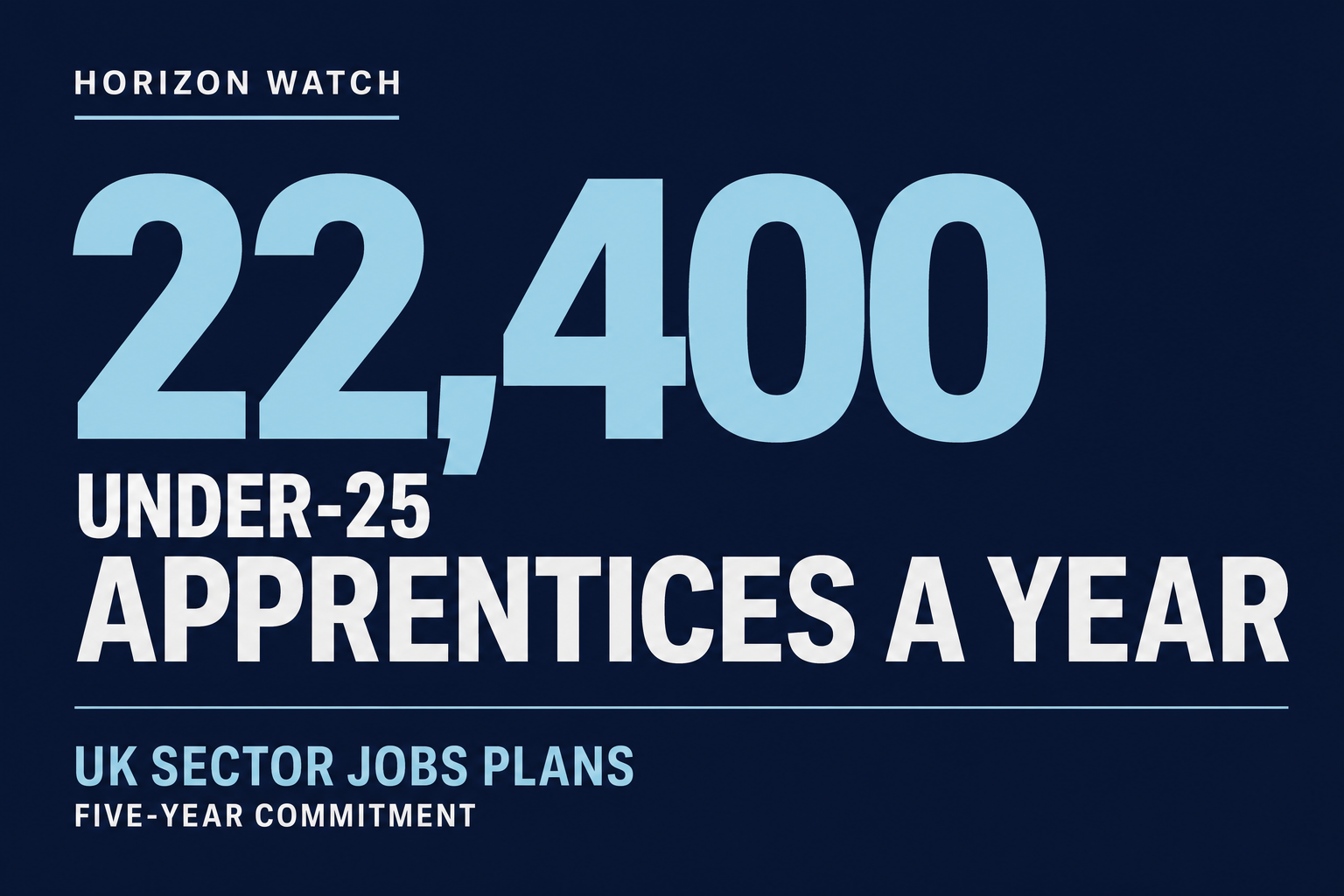
Professional and business services employers have committed to recruiting 22,400 people under 25 into apprenticeships each year for five years. The commitment covers accountancy, legal services and consultancy firms, and is accompanied by a pledge to increase young people’s work-experience opportunities by 20%.
The plans also identify opportunities and capability needs spanning accountancy, business, law, AI, cyber security and data analytics. Employers are expected to establish systems for tracking recruitment and supporting young people who are not in education, employment or training. These are commitments and planned systems, not evidence that the routes or tracking mechanisms are already operating at scale.
Construction adds a place-based workforce model
A separate construction plan includes 40,000 placements annually, within an existing industry ambition to create 100,000 job opportunities each year. It proposes a Construction Apprenticeship Network to support recruitment and participation by smaller businesses.
The construction plan also calls for workforce planning at national, regional and local levels across homebuilding, infrastructure, repair and maintenance, and professional and technical roles. It identifies preparation for AI and industrialised construction as part of the capability agenda, with mayors, employers and Local Skills Improvement Plans helping shape local routes into work.
Why this matters for enterprise learning
The practical learning consequence is a shift from treating apprenticeships as isolated early-career programmes to treating them as part of workforce planning. Employers will need to define the job capabilities behind broad labels such as AI literacy, cyber security and data analytics, then connect those capabilities to structured practice, supervision and assessment.
The scale of the commitments may also expose operational constraints. A larger intake requires enough trained supervisors, suitable work tasks, consistent assessment and routes for smaller employers to participate. The evidence does not yet show delivery rates, learner outcomes or employer adoption, so the appropriate Horizon conclusion is to prepare and monitor rather than assume success.
Article body revision 1 · added 2026-10-25. Assessment and source verification dates remain those recorded below.
Assessment overview
StateEmerging signal
DirectionUnder observation
MomentumUnassessed
MaturityUnverified
ConsequenceThe commitments could increase demand for structured work-based learning and make capability definitions more important in workforce planning.
Hype gapAnnouncement is not adoption or outcome proof
ConfidenceC
ActionWATCH
Published automatically under market-editorial-8. Evidence checked 2026-10-25.
Generated editorial illustration; source evidence is linked below.
What changed
On 19 October 2026, the UK government published professional and business services and construction sector jobs plans. The reported commitments include 22,400 under-25 apprentices annually for five years in professional and business services, a 20% increase in work experience, and 40,000 construction placements annually. The plans also name AI literacy, cyber security, data analytics and industrialised-construction capability needs.
Why it matters
The commitments could increase demand for structured work-based learning and make capability definitions more important in workforce planning. The relevant consequence is implementation readiness: employers may need to design supervised pathways for digital and technical skills while maintaining evidence of progression. No delivery or adoption outcome is established by the source.
What to watch
Create a six-month readiness review. Inventory current apprenticeships, placements, supervisors and assessment capacity; map the named capability areas to priority roles; and select a small pilot with clear workplace outcomes. Reassess once official implementation guidance, employer reporting and early delivery evidence become available.
Evidence boundary
The commitments may not translate into placements or successful learning without sufficient supervisors, meaningful work and consistent assessment. Broad capability labels may produce shallow AI or data training if they are not tied to job tasks. There is also a risk of counting recruitment or placements without measuring completion, progression or workplace capability.
Watch. The published plans create a concrete planning signal for apprenticeship and work-based learning teams, particularly in professional and business services and construction. They do not yet demonstrate implementation, learner outcomes or scalable employer capability. Enterprises should map the commitments to role-specific skills and delivery capacity before making programme or platform investments.
Momentum: Unassessed · Maturity: Unverified · Consequence: The commitments could increase demand for structured work-based learning and… · Confidence: C