Are enterprise learning platforms converging on AI assistants and agents?
Enterprise learning vendors increasingly use the words assistant, tutor, companion and agent. The underlying developments are easier to understand when grouped by the work they perform: retrieval, learner support, analysis and administrative action.
Evidence CDecision horizon 6 monthsUpdated 09 Oct 2026
Editorial context for Are enterprise learning platforms converging on AI assistants and agents?
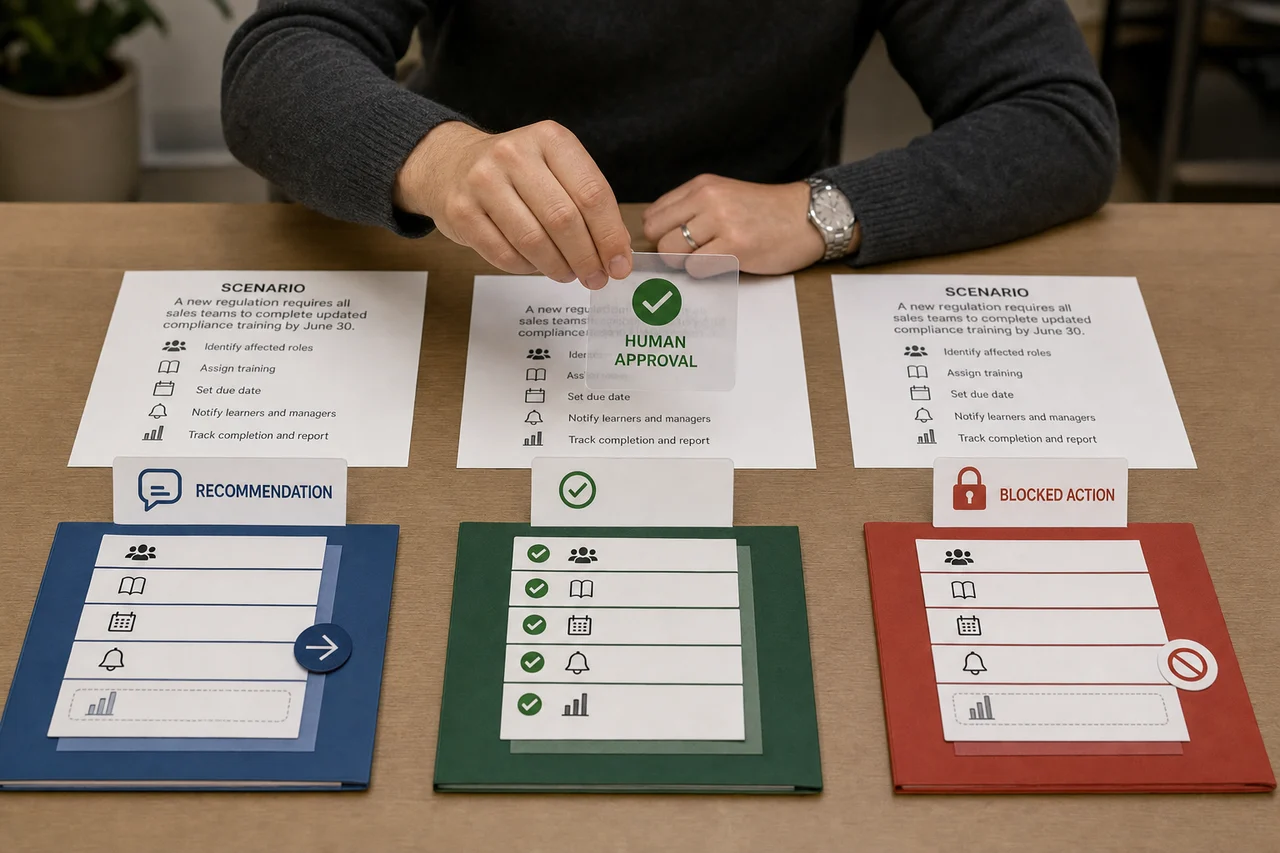
LT Horizon generated editorial illustration · not evidenceImage provenanceLT Horizon Visual Editor v2 · GPT-Image-2 generated editorial illustration; never evidence.
Assistance during learning
Cornerstone's release distinguishes a Course Assistant from an Adaptive Learning Agent. The first supports questions within a course; the second describes role- and skill-specific spaces, recommendations, quizzes and role-play. Both address learner experience, but at different levels of the journey.
360Learning's Search Mode similarly focuses on obtaining an answer from learning content. A retrieval experience can help someone use knowledge without navigating an entire course, but that is a different task from creating or changing a formal learning assignment.
Analysis and execution
360Learning's Insights Mode provides conversational access to learning analytics. Docebo's platform direction describes agents connected to enterprise knowledge, skills and tools through MCP. These introduce different questions about what information is being analysed and which operations a connection makes possible.
The distinction between an answer and an action is central. A system can return a useful recommendation without having authority to implement it. An action-capable workflow also needs an understood scope and a way to handle the effects of a change.
Convergence does not mean equivalence
The sources show vendors moving beyond isolated content-generation features into several parts of learning operations. They do not show that similarly named products have the same autonomy, integrations or controls.
Availability also differs. A released mode, a documented release capability and an announced platform direction are separate evidence states. This is why the comparison below uses common scenarios and capability boundaries: the convergence is real in product direction, while the specific tasks and maturity remain distinct.
How to read this briefCheck the sources to see what is documented. Our recommendation explains what that means for your decision. Proof patterns add specific design or implementation examples and explain their limits.
LT Horizon DECISION BRIEF
Answer
Cornerstone, Docebo and 360Learning describe assistants and agents for different tasks, including course questions, coaching, search, analytics and administration. Compare the task you need to perform, the data each tool can access and the approvals it requires. Confirm availability for each feature.
Who should care
L&D leaders, learning-technology buyers, enterprise architects, AI governance teams and organisations comparing suite-native Learning with specialist platforms.
Recommended action
INVESTIGATE — replace generic AI scorecards with scenario-based testing that measures grounding, action scope, governance, integration reach and learner/administrator value.
LT Horizon interpretation · Evidence confidence C
What changed
Multiple specialist learning vendors have moved AI from content-generation features toward embedded assistants, coaching, analytics and agentic actions during 2026.
Why it matters
The same AI label can refer to search, coaching, course delivery or administrative actions. Check the task, data access and approvals behind each feature before comparing products.
Implementation implications
Prerequisites
Map the organisation’s desired use cases by learner, manager, administrator and content-creator persona; identify data sources; define which actions can be automated; and set evidence, privacy and approval requirements before comparing products.
Architecture implications
MCP connections and embedded assistants can give AI access to learning tools and data. Agree which operations they may perform and test the permissions for each connection.
Risks
Vendor terms such as agent, assistant, companion and tutor are not standardised. Similar marketing language can hide very different levels of autonomy, data access, action rights and evidence grounding.
Testing implications
Compare the same scenarios across products: answer a policy question, recommend learning, coach a learner, create content, inspect skills gaps and perform an administrative action. Record what data was used, whether the result is traceable and what human approval remains.
Source register
What the evidence establishes
Cornerstone launches AI-Powered Course Assistant and Adaptive Learning Agent
Public summary awaiting review. See the original source.
Publication review is recorded in the evidence and correction history. Images illustrate the article; they are not evidence.
History and corrections
Article body revision 1 · added 09 Oct 2026. Explanatory text added to the published evidence snapshot; evidence confidence, availability and source verification dates are unchanged.
Published revisions are retained. Update dates change only after a change to the content or evidence.
Correction: Evidence grade corrected from A to C on 30 September 2026. The cited sources support documented product claims but do not provide independent proof from live implementations. Wording was also reviewed for clarity. Source verification dates are unchanged. · 30 Sept 2026
Keep a clearer view of learning technology.
Get occasional email updates when LT Horizon publishes new Intelligence and Horizon articles. Free to read, with no account required.
Our practical newsletter format brings one question, one idea and one exercise, alongside selected source-linked articles. Editions follow useful reviewed evidence.