Can SAP SuccessFactors Learning work without Employee Central?
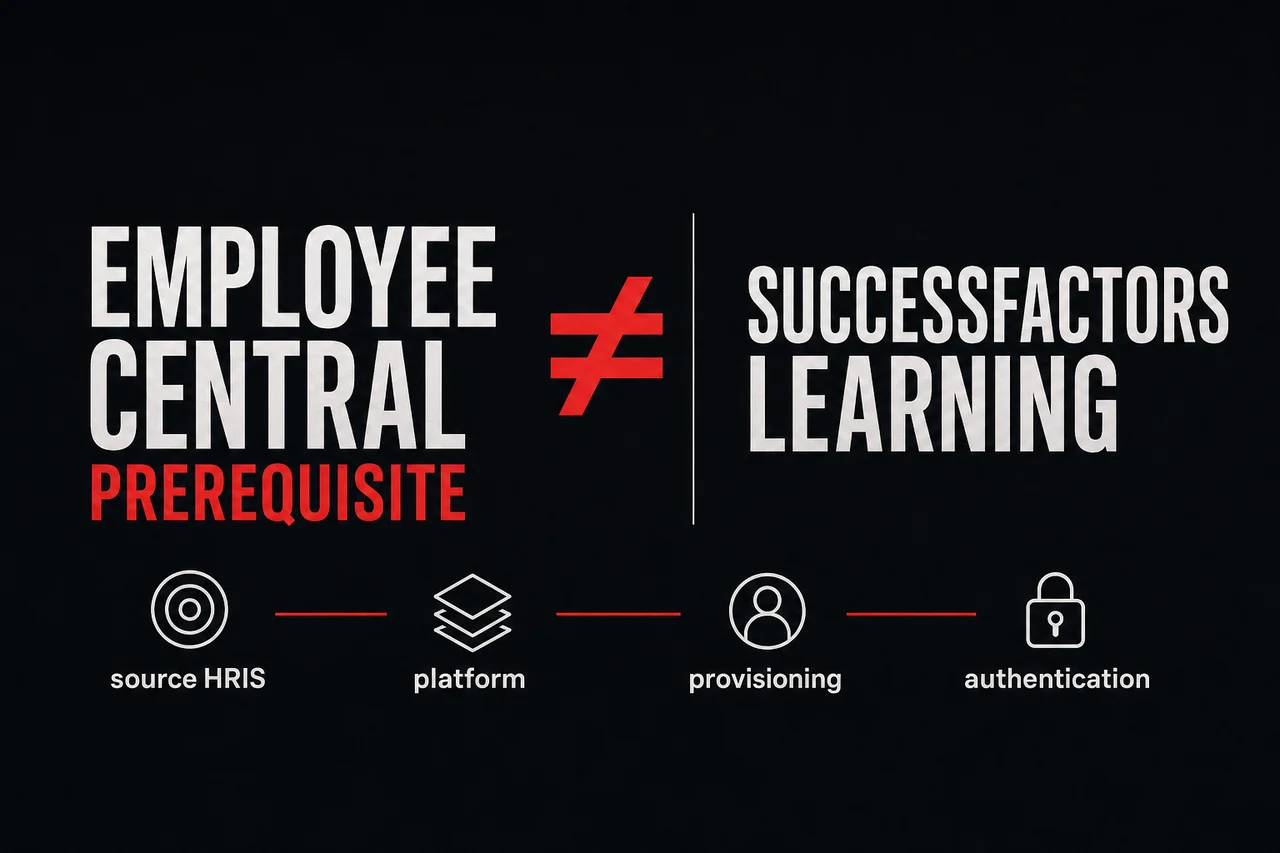
SuccessFactors Learning does not depend on Employee Central being the workforce system of record. Understanding that statement requires separating the HR source, the SuccessFactors Platform, the Learning user model and the services that manage access.
Evidence CDecision horizon NowUpdated 10 Oct 2026Proof patterns 2
Editorial context for Can SAP SuccessFactors Learning work without Employee Central?
LT Horizon generated editorial illustration · not evidenceImage provenanceLT Horizon Visual Editor v2 · GPT-Image-2 generated editorial illustration; never evidence.
Four layers, four different responsibilities
Employee Central holds HR data in an SAP-centred workforce architecture. SuccessFactors Platform provides the wider suite environment, while Learning has its own user attributes, assignments and learning records. Authentication answers a different question again: whether the person signing in can establish the right identity and access the service.
SAP's product overview describes Learning as usable on its own or within the wider suite. Its documentation also describes Learning-only populations and Cloud Identity Services integration. Together, those sources support a narrower conclusion than the word standalone sometimes suggests: Employee Central is not required for every Learning population, but platform, identity, provisioning and commercial requirements still exist.
How a non-Employee Central design fits together
In a non-EC landscape, another HR system may remain authoritative for workforce information. The architecture still needs an agreed route for the identifiers and attributes used by Learning, together with a lifecycle for changes and deactivation. That route cannot be inferred simply from the fact that two products are present in the same organisation.
User Connector – SAP SuccessFactors documents the Platform-to-Learning part of this picture. It does not, by itself, specify an upstream connection from every possible HR system. A working source feed, an authenticated user and a correctly maintained Learning record are distinct results, each with its own responsibility.
What the examples establish
The cited Endress+Hauser story shows Learning used for partner training. The GP Strategies migration story includes inbound Workday integrations. These are useful examples of different population and integration contexts, but neither supplies a universal tenant architecture.
The practical distinction is therefore between product capability and a supported design for a particular population. The evidence supports investigating a non-EC model; it does not establish that every customer can use the same topology, entitlement or provisioning direction.
LT Horizon interpretation · illustrative worked example · 10 October 2026
A mixed HR and learning landscape
Imagine an organisation keeping Workday as its workforce system while using SAP SuccessFactors Learning. This is an illustrative design exercise, not a reported customer configuration.
Separate the decisions: Workday supplies authoritative workforce data; the SuccessFactors platform and Learning need the appropriate user representations; authentication determines how a person signs in. Confirm the supported flow and entitlements for the actual tenant.
Walk through one joiner, one employee move and one leaver. Record which system changes first, how the change reaches Learning, and who reconciles a missed or duplicate update. Test assignment-driving attributes separately from successful sign-in.
Decision: The question is not simply whether Employee Central is present. It is whether the supported user, data and identity responsibilities are complete and owned.
This example applies the reviewed article’s reasoning. It adds no product availability claim, customer evidence or change to the evidence grade.
How to read this briefCheck the sources to see what is documented. Our recommendation explains what that means for your decision. Proof patterns add specific design or implementation examples and explain their limits.
LT Horizon DECISION BRIEF
Answer
SAP documentation supports the narrow conclusion that SuccessFactors Learning can operate without Employee Central being the authoritative workforce system. Employee Central is therefore not a universal prerequisite. Any non-Employee Central design still requires supported user, identity, provisioning and integration controls, and this does not by itself prove a direct Workday-to-Learning integration, universal tenant support or commercial entitlement.
Who should care
Learning owners, HRIT leads, solution architects and organisations retaining Workday, Oracle, SAP human capital management or another workforce system of record.
Recommended action
INVESTIGATE — document the four separate layers: source HRIS, SuccessFactors Platform, Learning user provisioning and authentication.
LT Horizon interpretation · Evidence confidence C
Why it matters
Treating Employee Central and SuccessFactors Platform as the same dependency leads to poor architecture decisions. The workforce source, platform user representation, Learning user record and authentication path must be considered separately.
Use cases & proof
Where this holds up in practice
These examples show how a specific claim is supported by documentation or an implementation. Read their limits before applying them to your own environment.
Proof pattern · Evidence C
Learning-only users with SAP Cloud Identity Services
Scenario
A learning population uses SAP SuccessFactors Learning without relying on an Employee Central employee record for the same user journey.
Architecture pattern
Learning user population → SAP Cloud Identity Services identity/provisioning pattern → SAP SuccessFactors Learning, with source-of-truth and lifecycle controls explicitly defined.
Observed / documented outcome
SAP documents the Learning-only Cloud Identity Services pattern and Learning Sites for extended-enterprise access. A named Endress+Hauser customer story separately demonstrates real use of SuccessFactors Learning to train partners in an extended-enterprise model, with a dedicated onboarding solution around that population.
What this proves
Employee Central is not the only possible basis for every Learning user population. SAP documents Learning-only identity and access patterns, and named customer evidence shows SuccessFactors Learning being used operationally for partner populations outside the internal workforce.
What it does not prove
It does not prove that Endress+Hauser uses the exact IAS/IPS topology described in the official documentation, that all internal employee populations should bypass Employee Central, that identity services replace authoritative workforce data, or that one external-user pattern is suitable for every tenant.
Apply with these constraints
Define registration, authoritative data, identity tenancy, unique identifiers, provisioning direction, privacy, account recovery, deactivation, retention and support ownership by population. Confirm the supported identity flow for the specific tenant rather than inferring it from the customer case.
Last checked 18 Sept 2026 · Reviewed before publication.
Proof pattern · Evidence C
Workday as a workforce source with SAP SuccessFactors Learning
Scenario
An organisation retains Workday as a workforce system while using SAP SuccessFactors learning technology in a mixed enterprise architecture.
Architecture pattern
Workday and internal applications → governed workforce integration → SuccessFactors user/platform layer → Learning; authentication and identity controls remain separate design decisions.
Observed / documented outcome
A published implementation case study documents inbound integrations from Workday and internal applications as part of a SuccessFactors learning management system migration involving more than three million learning-history records.
What this proves
Employee Central is not universally required to be the authoritative workforce system for an organisation using SuccessFactors Learning. A third-party HR system can participate in a governed SuccessFactors Learning architecture.
What it does not prove
It does not prove that Workday connects directly to Learning without the SuccessFactors platform/user layer; it does not prove every tenant, entitlement or integration design is supported; and it does not establish adoption or maturity across the market.
Apply with these constraints
Confirm commercial entitlement, SuccessFactors platform user representation, the supported integration mechanism, identifiers, joiner/mover/leaver ownership, connector timing and authentication for the specific tenant.
Last checked 18 Sept 2026 · Reviewed before publication.
Implementation implications
Prerequisites
Confirm commercial entitlement, the supported tenant architecture, authoritative workforce source, user provisioning method, identity provider and responsibility for lifecycle reconciliation.
Architecture implications
A non-Employee Central design still needs a controlled route from the authoritative HR system into the SuccessFactors environment and Learning. The exact supported pattern must be confirmed for the tenant.
Risks
The SAP documentation supports a Learning-only identity/provisioning pattern, but it also documents platform activation, identity and provisioning prerequisites. “Standalone” must not be interpreted as permission to bypass supported platform, identity, provisioning or commercial requirements.
Testing implications
Test joiners, movers, leavers, inactive users, identity matching, duplicate prevention, assignment-driving attributes and reconciliation back to the source HR system.
Source register
What the evidence establishes
Endress+Hauser uses SuccessFactors Learning for partner training
SAP’s named customer story describes extended-enterprise training for partners and an onboarding application. It does not disclose the customer’s complete authentication or provisioning design, so it cannot establish a universal Learning-only architecture.
Availability: Named customer outcome hosted by SAP. It evidences real extended-enterprise use of SuccessFactors Learning but does not disclose the customer's IAS/IPS tenant topology, provisioning direction or exact Learning-only authentication design.
Dual LMS migration with inbound Workday integrations
GP Strategies describes a migration involving SAP SuccessFactors learning technology, inbound Workday data and historical learning records. This implementation example shows that the HR data source and learning platform can differ; it does not establish a standard integration for every customer.
Availability: Observed implementation case study; does not establish a universal supported integration pattern.
SAP documents distinct site URLs for groups of Learning-only users, including registration, branding and guest catalogue access. A site is separate from authentication: Identity Authentication controls how the user signs in.
Learning and SAP Cloud Identity Services integration overview
SAP identifies Identity Authentication as the login service for Learning-only users. Identity Provisioning orchestrates identity transfers between applications, including Learning-to-Identity Authentication provisioning; these responsibilities are separate from maintaining employee HR data.
SAP describes SuccessFactors Learning as a standalone product or part of its human capital management suite. This product description does not, by itself, establish that every implementation can dispense with platform, identity or data-provisioning dependencies.
SAP requires Platform fields to be mapped to Learning before User Connector – SAP SuccessFactors synchronises users. The documentation also says connector mappings and the user update event bus should agree when both update the same users.
Publication review is recorded in the evidence and correction history. Images illustrate the article; they are not evidence.
History and corrections
Article body revision 1 · added 09 Oct 2026. Explanatory text added to the published evidence snapshot; evidence confidence, availability and source verification dates are unchanged.
Illustrative worked example added 10 October 2026. Source verification dates and evidence confidence are unchanged.
Published revisions are retained. Update dates change only after a change to the content or evidence.
Revision 3 · published 08 Oct 2026 · updated 08 Oct 2026
Revision 1 · published 18 Sept 2026 · updated 08 Oct 2026
No material correction notes.
Keep a clearer view of learning technology.
Get occasional email updates when LT Horizon publishes new Intelligence and Horizon articles. Free to read, with no account required.
Our practical newsletter format brings one question, one idea and one exercise, alongside selected source-linked articles. Editions follow useful reviewed evidence.