How do external learners work in SAP SuccessFactors Learning?
External learners in SuccessFactors Learning can use Learning-only accounts and Learning Sites. The product pattern supports a distinct training population, while the organisation still needs an operating model for how those people enter, access and leave the service.
Evidence CDecision horizon NowUpdated 09 Oct 2026Proof patterns 1
Learning-only users need an operating model.
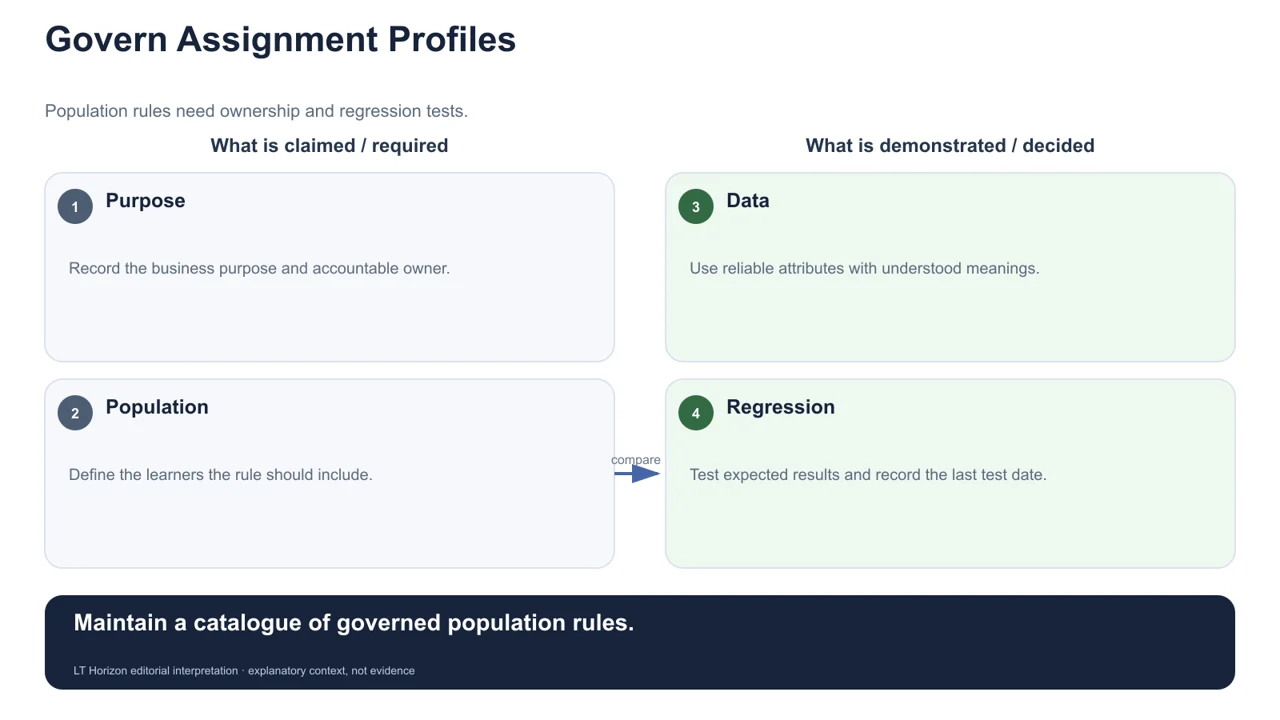
LT Horizon generated editorial illustration · not evidenceImage provenanceLT Horizon owner-supplied editorial assetView diagram at full size
Read diagram text
Keep roadmap plans separate from tenant evidence. Roadmap: Record the planned feature and its stated availability. Preview: Check configuration and behaviour in your tenant. Dependencies: Identify access, data and implementation requirements. Decision: Plan adoption only around behaviour you have verified.
What a Learning Site provides
SAP describes a site as a URL associated with a group of Learning-only users. Administrators can define registration, branding and guest access to the library. This allows a partner or customer population to encounter a learning environment appropriate to that context.
The registration form captures information used to create the Learning-only account. That is different from an employee record maintained through an internal HR process. The organisation consequently needs to understand who supplies and maintains the external user's information.
Site access and authentication are separate
SAP explicitly distinguishes Sites from authentication. A user associated with one site can authenticate through another under the documented conditional-authentication arrangements in Identity Authentication.
The site therefore provides part of the entry experience, not a complete identity design by itself. The account, the sign-in path and the learning permissions form related but separate parts of the user's journey.
What the implementation evidence shows
The cited Endress+Hauser customer story describes partner training through SuccessFactors Learning and a dedicated onboarding solution. It demonstrates a real extended-enterprise use case without supplying the exact tenant identity and provisioning configuration.
The explanation is therefore both product and operating model: Learning-only accounts and Sites create a supported population pattern, while registration assurance, support, lifecycle and retention still belong to the organisation's design. The actions below concern those responsibilities rather than assuming external learning is solved by adding a new user type.
How to read this briefCheck the sources to see what is documented. Our recommendation explains what that means for your decision. Proof patterns add specific design or implementation examples and explain their limits.
LT Horizon DECISION BRIEF
Answer
External learning is an operating model, not simply a user type. SAP Learning Sites support Learning-only users, but the design must also define registration, identity, privacy, support and lifecycle ownership.
Who should care
Extended-enterprise programme owners, security architects, privacy leads, customer training teams and Learning administrators.
Recommended action
PLAN — approve an external-learner operating model before configuring sites or bulk-loading users.
LT Horizon interpretation · Evidence confidence C
Why it matters
External populations often have weaker authoritative data and different identity, consent, support and retention requirements than employees.
Use cases & proof
Where this holds up in practice
These examples show how a specific claim is supported by documentation or an implementation. Read their limits before applying them to your own environment.
Proof pattern · Evidence C
Learning-only users with SAP Cloud Identity Services
Scenario
A learning population uses SAP SuccessFactors Learning without relying on an Employee Central employee record for the same user journey.
Architecture pattern
Learning user population → SAP Cloud Identity Services identity/provisioning pattern → SAP SuccessFactors Learning, with source-of-truth and lifecycle controls explicitly defined.
Observed / documented outcome
SAP documents the Learning-only Cloud Identity Services pattern and Learning Sites for extended-enterprise access. A named Endress+Hauser customer story separately demonstrates real use of SuccessFactors Learning to train partners in an extended-enterprise model, with a dedicated onboarding solution around that population.
What this proves
Employee Central is not the only possible basis for every Learning user population. SAP documents Learning-only identity and access patterns, and named customer evidence shows SuccessFactors Learning being used operationally for partner populations outside the internal workforce.
What it does not prove
It does not prove that Endress+Hauser uses the exact IAS/IPS topology described in the official documentation, that all internal employee populations should bypass Employee Central, that identity services replace authoritative workforce data, or that one external-user pattern is suitable for every tenant.
Apply with these constraints
Define registration, authoritative data, identity tenancy, unique identifiers, provisioning direction, privacy, account recovery, deactivation, retention and support ownership by population. Confirm the supported identity flow for the specific tenant rather than inferring it from the customer case.
Last checked 18 Sept 2026 · Reviewed before publication.
Implementation implications
Prerequisites
Define the external population, lawful data basis, registration route, identity pattern, account ownership, duplicate controls, support model and retention policy.
Architecture implications
Separate employee, contingent-worker and external-customer patterns. Do not assume the employee provisioning and authentication model is appropriate for every population.
Risks
Orphaned accounts, duplicate identities, inappropriate access, unclear password support, weak data retention controls and incorrect use of employee-oriented processes.
Testing implications
Test registration, verification, duplicate handling, password recovery, access boundaries, deactivation, deletion and support hand-offs.
Source register
What the evidence establishes
Endress+Hauser uses SuccessFactors Learning for partner training
SAP’s named customer story describes extended-enterprise training for partners and an onboarding application. It does not disclose the customer’s complete authentication or provisioning design, so it cannot establish a universal Learning-only architecture.
Availability: Named customer outcome hosted by SAP. It evidences real extended-enterprise use of SuccessFactors Learning but does not disclose the customer's IAS/IPS tenant topology, provisioning direction or exact Learning-only authentication design.
SAP documents distinct site URLs for groups of Learning-only users, including registration, branding and guest catalogue access. A site is separate from authentication: Identity Authentication controls how the user signs in.
Learning and SAP Cloud Identity Services integration overview
SAP identifies Identity Authentication as the login service for Learning-only users. Identity Provisioning orchestrates identity transfers between applications, including Learning-to-Identity Authentication provisioning; these responsibilities are separate from maintaining employee HR data.
SAP describes SuccessFactors Learning as a standalone product or part of its human capital management suite. This product description does not, by itself, establish that every implementation can dispense with platform, identity or data-provisioning dependencies.
Publication review is recorded in the evidence and correction history. Images illustrate the article; they are not evidence.
History and corrections
Article body revision 1 · added 09 Oct 2026. Explanatory text added to the published evidence snapshot; evidence confidence, availability and source verification dates are unchanged.
Published revisions are retained. Update dates change only after a change to the content or evidence.
Get occasional email updates when LT Horizon publishes new Intelligence and Horizon articles. Free to read, with no account required.
Our practical newsletter format brings one question, one idea and one exercise, alongside selected source-linked articles. Editions follow useful reviewed evidence.