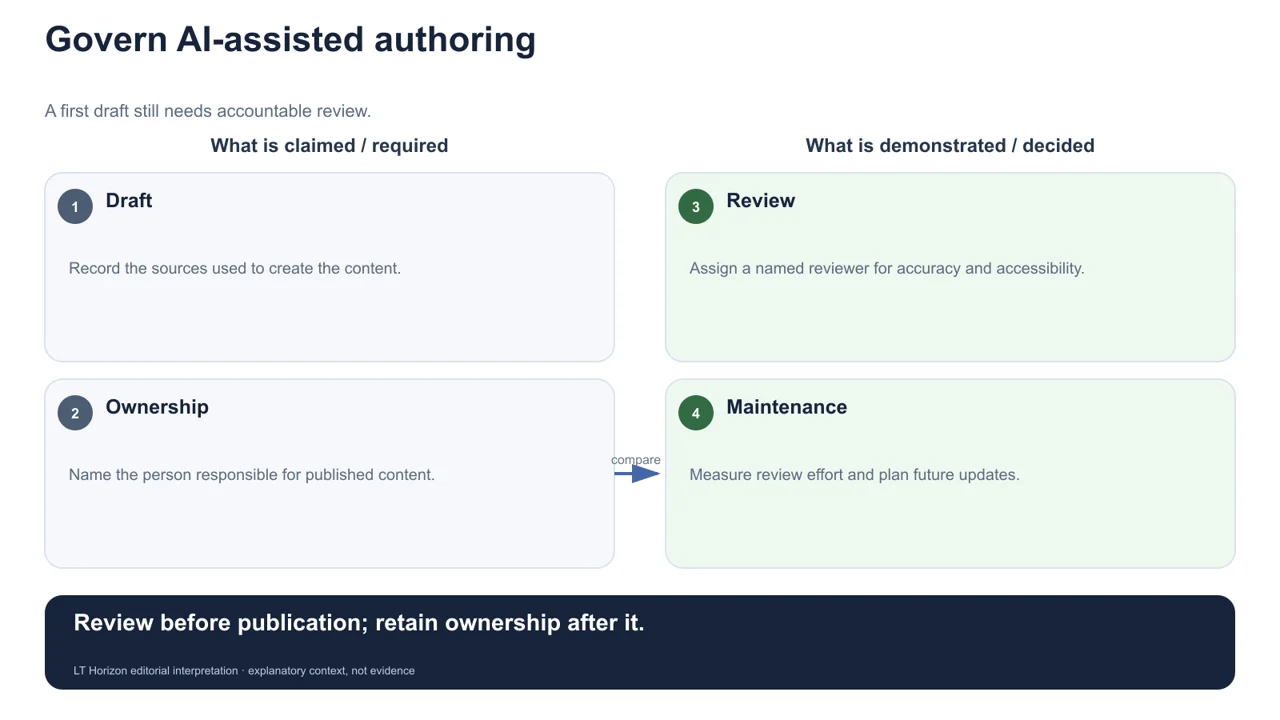
How should AI-assisted course authoring be governed?
AI-assisted authoring changes the way a course draft is produced. The full operating lifecycle still includes sources, review, activation, delivery and later maintenance, each of which can involve different people and systems.
Evidence CDecision horizon NowUpdated 09 Oct 2026Proof patterns 1
Keep roadmap plans separate from tenant evidence.
LT Horizon generated editorial illustration · not evidenceImage provenanceLT Horizon owner-supplied editorial assetView diagram at full size
Read diagram text
Keep roadmap plans separate from tenant evidence. Roadmap: Record the planned feature and its stated availability. Preview: Check configuration and behaviour in your tenant. Dependencies: Identify access, data and implementation requirements. Decision: Plan adoption only around behaviour you have verified.
From source material to draft
Workday's combined Learning and Sana proposition includes AI-native authoring. Source material provides the basis from which a draft is generated, while the model assembles an explanation or activity that still needs to be evaluated.
The generated output is therefore a new representation of the source, not the source itself. A reviewer needs to understand both the intended learning task and the underlying material to identify omissions, incorrect emphasis or unsupported statements.
Publication connects authoring to administration
Workday's administrator documentation separates Sana authoring and learner experience from Workday Learning's system-of-record responsibilities. Assignments, enrolments, learning records and reporting remain administrative concerns even when the content-production experience changes.
This explains why an authoring improvement is not only a matter of producing material faster. The approved version must fit the catalogue, the intended population and the evidence retained when learning is completed. Changes to published content can also create ongoing review and maintenance work.
Governance follows the lifecycle
NIST's generative-AI guidance addresses provenance, testing and human review. Applied here, those relationships connect approved inputs, the generated draft, the review decision and the version that reaches learners.
This article concerns ownership of the operating lifecycle. The separate generated-content evaluation article focuses on checking the output itself. The guidance below keeps that distinction while asking whether the complete production process improves, including the work needed to review, support and update a course.
How to read this briefCheck the sources to see what is documented. Our recommendation explains what that means for your decision. Proof patterns add specific design or implementation examples and explain their limits.
LT Horizon DECISION BRIEF
Answer
AI can help produce a first course draft. Keep a named reviewer, record the sources and check accuracy and accessibility before publication. Measure review and maintenance time as well as drafting time.
Who should care
Instructional design teams, learning operations, subject-matter experts, risk and compliance teams and content owners.
Recommended action
PLAN — establish an AI authoring control standard before scaling generation across the content catalogue.
LT Horizon interpretation · Evidence confidence C
What changed
Generative authoring is moving into mainstream learning platforms, reducing the technical barrier to producing and revising learning content.
Why it matters
Faster drafting can leave more content waiting for review. Plan enough time to check accuracy, assign ownership and maintain published courses.
Use cases & proof
Where this holds up in practice
These examples show how a specific claim is supported by documentation or an implementation. Read their limits before applying them to your own environment.
Proof pattern · Evidence C
Workday Learning remains the system of record while Sana changes authoring and learner experience
Scenario
An organisation adopts Workday Learning, powered by Sana either as a new Workday Learning deployment or by adding the Sana capability to an existing Workday Learning estate.
Architecture pattern
Workday Learning system of record, catalog, assignments, enrollments, reporting and permissions → integrated Sana provisioning → Sana Create authoring and Sana in-lesson learner experience → status and completion updates retained in Workday Learning.
Observed / documented outcome
Workday administrator documentation defines a split operating model between Workday Learning and Sana. Workday also reports that its own L&D team used Sana Learn for three years across a global workforce before planning the integrated Workday Learning, powered by Sana rollout.
What this proves
Workday Learning, powered by Sana is not simply a front-end replacement. Workday Learning remains the system of record for core learning administration while Sana changes authoring and in-lesson experience, creating real security, provisioning, content-lifecycle and operating-model decisions for adopters.
What it does not prove
It does not prove that migration is low effort, that every Workday tenant is entitled or ready to enable the capability, that Workday’s internal Sana Learn outcomes will transfer to other organisations, or that Workday’s internal team had completed production deployment of the fully integrated offering when its case was published.
Apply with these constraints
Confirm subscription entitlement, tenant activation, Workday/Sana tenant linkage, security domains, provisioning, creator roles, content migration and reuse expectations, reporting continuity, regulated or sovereign environment constraints, accessibility, audit requirements and measurable rollout outcomes.
Last checked 18 Sept 2026 · Reviewed before publication.
Implementation implications
Prerequisites
Approved source material, named content owner, review workflow, accessibility standard, versioning approach, retention policy and rules for restricted or regulated content.
Architecture implications
Generated content should remain traceable to source material, approval state and published version. Avoid treating the model output as the authoritative source.
Risks
Confident inaccuracies, stale policy content, inaccessible generated media, loss of provenance, uncontrolled duplication and apparent productivity gains that reappear as review or maintenance cost.
Testing implications
Compare generated output with source material, test accessibility, verify assessments and answers, track reviewer corrections, measure end-to-end production time and sample content again after later source changes.
Source register
What the evidence establishes
What changed with Workday Learning, powered by Sana? — Workday evidence
Public summary awaiting review. See the original source.
Publication review is recorded in the evidence and correction history. Images illustrate the article; they are not evidence.
History and corrections
Article body revision 1 · added 09 Oct 2026. Explanatory text added to the published evidence snapshot; evidence confidence, availability and source verification dates are unchanged.
Published revisions are retained. Update dates change only after a change to the content or evidence.
Correction: Evidence grade corrected from B to C. The cited documentation or standard supports the guidance; independent implementation proof has not been reviewed. Wording reviewed for clarity; source verification dates are unchanged. · 30 Sept 2026
Keep a clearer view of learning technology.
Get occasional email updates when LT Horizon publishes new Intelligence and Horizon articles. Free to read, with no account required.
Our practical newsletter format brings one question, one idea and one exercise, alongside selected source-linked articles. Editions follow useful reviewed evidence.