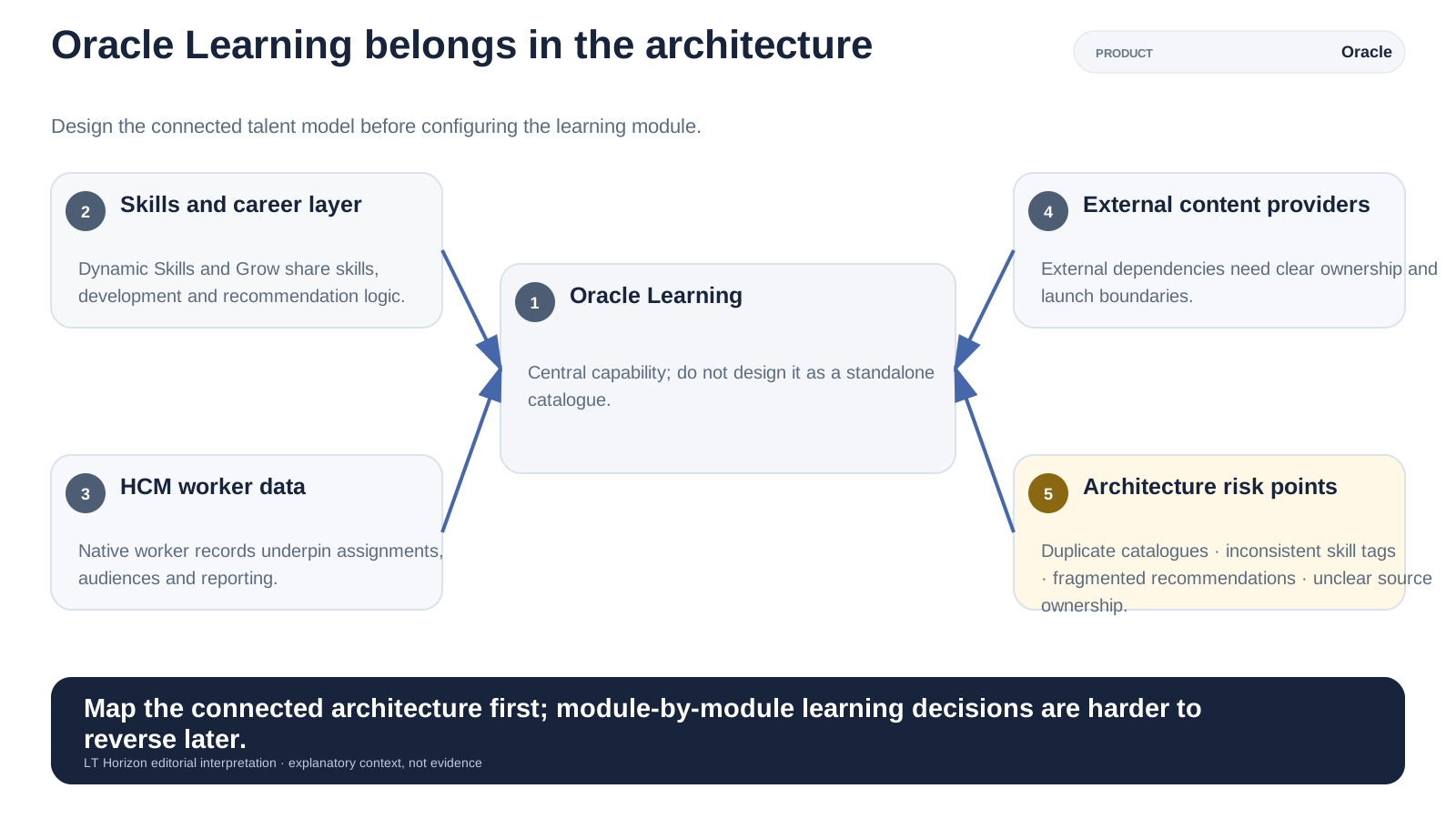
Oracle Learning sits within a wider talent architecture that connects worker information, skills, learning opportunities and formal records. Explaining those relationships comes before deciding which module or integration should own a particular experience.
Evidence CDecision horizon NowUpdated 09 Oct 2026Proof patterns 1
Editorial context for How should Oracle Learning fit into the wider talent architecture?
LT Horizon generated editorial illustration · not evidenceImage provenanceLT Horizon deterministic SVG generated from a source-reviewed editorial visual contract; explanatory context only, never evidence.View diagram at full size
Read diagram text
A sparse system map places Oracle Learning at the center, connected to a combined Dynamic Skills and Grow career layer, HCM worker data, and external content providers. Connection labels distinguish native Oracle relationships, native source dependency, and an external-provider boundary. A separate risk callout names duplicate catalogues, inconsistent skill tags, fragmented recommendations, and unclear source ownersh
Worker context and learning administration
Worker and organisational data provide context for who someone is and which learning may be relevant or required. Learning adds catalogues, assignments, participation and completion records. Oracle's assignment documentation describes how audiences and lifecycle stages turn that context into managed learning activity.
These are connected responsibilities rather than interchangeable data sets. A worker attribute may determine an audience, while the resulting learning record captures a different event. Changing one can affect the other without making them the same system of record.
Skills and wider development experiences
Oracle describes Dynamic Skills and Grow in the wider talent proposition. Skills information provides another relationship between people, roles and development opportunities, while learning content may be associated with the capabilities it is intended to support.
External content extends the picture beyond the suite. The cited Silver Fern Farms story describes using LinkedIn Learning with Oracle Learning and tracking development. It is a named implementation example, not proof of the exact configuration or results for every customer.
One learner journey can cross several boundaries
Discovery, assignment, launch and completion may depend on different components even when the learner experiences a single journey. Reporting and later talent decisions may then use the resulting records or skills context.
The architecture question is consequently how those components exchange information and retain ownership. The sources establish a connected product proposition and documented learning controls; they do not provide a universal design for every organisation's content providers, skills model or talent processes.
How to read this briefCheck the sources to see what is documented. Our recommendation explains what that means for your decision. Proof patterns add specific design or implementation examples and explain their limits.
LT Horizon DECISION BRIEF
Answer
Check Oracle Learning alongside the people data, skills, assignments and reporting it depends on. Agree how content and external providers fit into those processes.
Who should care
Oracle human capital management architects, Learning leads, talent leaders, integration teams and organisations considering Oracle Learning alongside other learning platforms.
Recommended action
INVESTIGATE — produce an Oracle talent architecture map before making module-by-module learning configuration decisions.
LT Horizon interpretation · Evidence confidence C
Why it matters
Decisions about catalogues, skills, recommendations and employee growth become harder to reverse when they are designed independently and later connected.
Use cases & proof
Where this holds up in practice
These examples show how a specific claim is supported by documentation or an implementation. Read their limits before applying them to your own environment.
Proof pattern · Evidence C
Oracle Learning joins talent architecture to governed assignment lifecycles
Scenario
An organisation uses Oracle Learning as part of its wider human capital management and talent estate while also relying on required, recurring or compliance-related learning assignments for defined workforce populations.
Architecture pattern
Oracle human capital management worker, role and talent context → Oracle Learning catalogue and external content → assignment profiles and audience rules → activation, completion, renewal or reassignment → reporting and talent-development outcomes.
Observed / documented outcome
Oracle documentation defines assignment profiles as rule-based controls over learning, audience, timing and recurrence, and documents lifecycle behaviour including renewal and reassignment. Named customer stories show Oracle Learning operating inside broader Cloud human capital management environments for workforce training, comprehension checks, external content and development tracking.
What this proves
Oracle Learning should be designed as part of the wider talent and workforce architecture rather than as an isolated course catalogue. Required and compliance learning depends on governed audience rules, assignment lifecycle, renewal or reassignment logic, content, reporting and operational ownership.
What it does not prove
It does not prove that Oracle Learning by itself satisfies a legal or regulatory compliance obligation, that Vesta or Silver Fern Farms use the exact assignment configuration described in Oracle documentation, that one audience model or recurrence period is appropriate for every organisation, or that customer-reported outcomes transfer universally.
Apply with these constraints
Define authoritative worker and role data, assignment ownership, audience criteria, required-versus-voluntary rules, due dates, recurrence and validity, renewal or reassignment conflicts, exceptions, content ownership, external-provider dependencies, completion evidence, reporting, audit and regression tests before relying on the design for compliance or talent decisions.
Last checked 18 Sept 2026 · Reviewed before publication.
Implementation implications
Prerequisites
Define the system of record for workers, skills ownership, external content providers, learning-assignment model, reporting responsibilities and target talent experiences.
Architecture implications
Map Oracle Learning, Dynamic Skills, Grow, external content and human capital management worker data as a connected talent architecture with explicit ownership boundaries.
Risks
Duplicate catalogues, inconsistent skills tagging, unclear source ownership, fragmented recommendations and over-customised integrations that duplicate native platform relationships.
Testing implications
Test worker changes, catalog synchronisation, skill-tagged content, recommendations, learning assignments, external content launches, completions and downstream talent experiences with end-to-end personas.
Source register
What the evidence establishes
How should Oracle Learning fit into the wider talent architecture? — Oracle evidence
Public summary awaiting review. See the original source.
Publication review is recorded in the evidence and correction history. Images illustrate the article; they are not evidence.
History and corrections
Article body revision 1 · added 09 Oct 2026. Explanatory text added to the published evidence snapshot; evidence confidence, availability and source verification dates are unchanged.
Published revisions are retained. Update dates change only after a change to the content or evidence.
Correction: Wording reviewed for clarity. The evidence grade and source verification dates are unchanged. · 30 Sept 2026
Keep a clearer view of learning technology.
Get occasional email updates when LT Horizon publishes new Intelligence and Horizon articles. Free to read, with no account required.
Our practical newsletter format brings one question, one idea and one exercise, alongside selected source-linked articles. Editions follow useful reviewed evidence.