Assignment Profiles select Learning user populations using attribute-based rules. Understanding their behaviour starts with the relationship between the user data, the matching rule and the learning assigned to the resulting pool.
Evidence CDecision horizon NowUpdated 09 Oct 2026Proof patterns 1
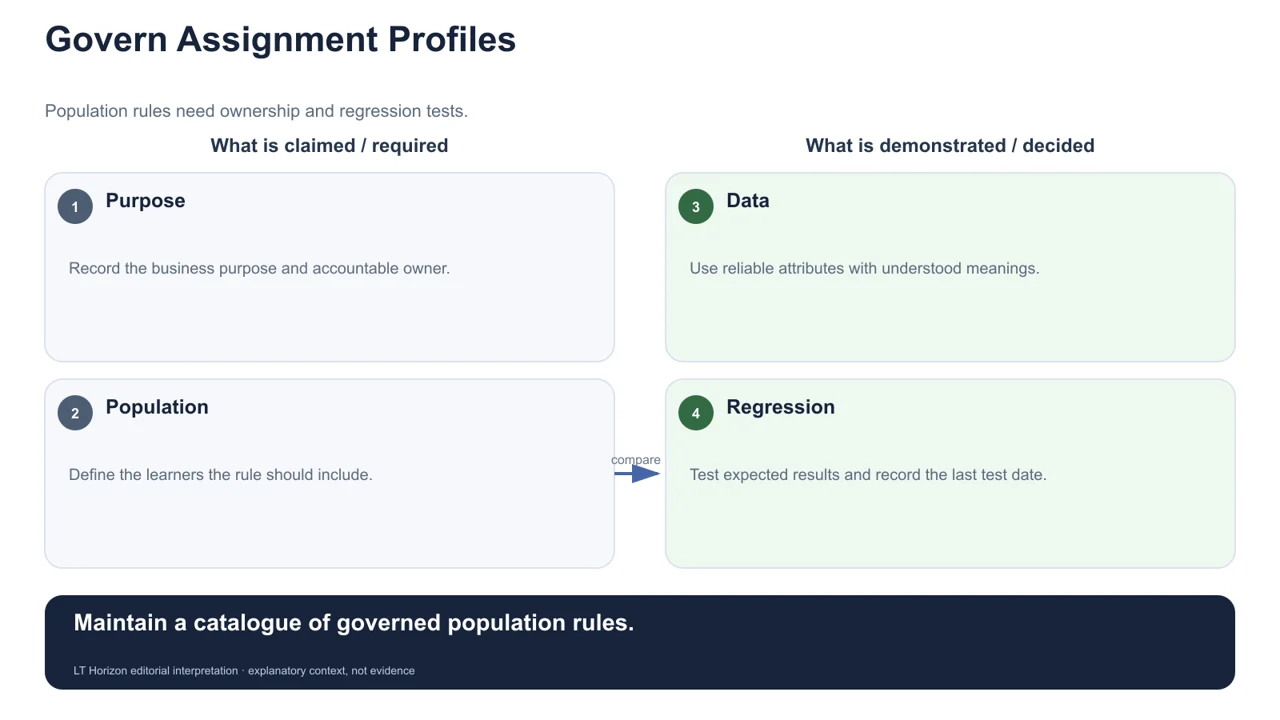
Population rules need ownership and regression tests.
LT Horizon generated editorial illustration · not evidenceImage provenanceLT Horizon owner-supplied editorial assetView diagram at full size
Read diagram text
Keep roadmap plans separate from tenant evidence. Roadmap: Record the planned feature and its stated availability. Preview: Check configuration and behaviour in your tenant. Dependencies: Identify access, data and implementation requirements. Decision: Plan adoption only around behaviour you have verified.
Rules create a population
SAP describes a profile as running rules to find users who match defined attributes. The resulting pool can receive assignments such as library access, courses or curricula. Profiles run periodically, so population membership can change as the underlying information changes.
A profile is therefore more than a saved filter. It creates a relationship between data and an operational result. If the input value changes, the intended learning population can change even when the administrator has not edited the profile itself.
An illustrative population change
Consider a profile intended for workers at a particular location. A worker's move changes the source location; the updated value must reach Learning before the profile can reflect the new situation. This is an illustration of the documented attribute-to-population relationship, not a tested configuration for a particular customer.
The same principle explains why blank, retired or inconsistent values matter. A rule can run successfully against the data it receives while producing a population that differs from the business owner's intention.
Why connector design belongs in the explanation
The cited SAP organisation-mapping example uses a durable identifier for downstream Learning relationships. A separate support incident shows a processed organisation change that did not update the learner record because required connector configuration was missing.
Those sources establish a concrete dependency between source data, the Learning record and later population selection. They do not imply that every assignment error has the same cause. The design guidance below follows this dependency and treats a profile as an owned population rule with an expected result.
How to read this briefCheck the sources to see what is documented. Our recommendation explains what that means for your decision. Proof patterns add specific design or implementation examples and explain their limits.
LT Horizon DECISION BRIEF
Answer
Design Assignment Profiles as governed population rules—not as convenient filters. Each profile needs a clear business purpose, reliable source attributes, an accountable owner and regression tests.
Who should care
Learning administrators, compliance owners, data teams and consultants designing automated assignments.
Recommended action
ACT — establish an Assignment Profile catalogue containing purpose, logic, owner, source attributes, expected population and last test date.
LT Horizon interpretation · Evidence confidence C
Why it matters
Assignment automation scales both good and bad data decisions. A weak rule can miss required learners or create unnecessary training at enterprise scale.
Use cases & proof
Where this holds up in practice
These examples show how a specific claim is supported by documentation or an implementation. Read their limits before applying them to your own environment.
An organisation uses Platform workforce attributes to maintain Learning user organisation values that are subsequently used to drive assignment populations and reporting.
Architecture pattern
Platform workforce attributes and durable organisation identifier → User Connector - SAP SuccessFactors field mapping → Learning ORG_ID → Assignment Profiles, reporting and learner population controls.
Observed / documented outcome
SAP documents both the durable ORG_ID mapping pattern and an operational support case where a workforce organisation change was processed but did not update the Learning user record because required connector organisation-domain configuration was missing.
What this proves
Field mapping and connector configuration can determine whether workforce changes reach the Learning user model correctly. Because organisation attributes are used to drive Learning populations, mapping design is an operational control rather than a simple technical translation.
What it does not prove
It does not prove that every learning-assignment error is caused by User Connector mapping, that every tenant should use the same organisation model, or that the documented support incident is common across the customer base.
Apply with these constraints
Confirm the authoritative attribute, durable identifier, Learning reference data, organisation-domain behaviour, one-to-one mapping constraints, copy-field requirements, source ownership, connector schedule and regression tests before relying on mapped values for assignments.
Last checked 18 Sept 2026 · Reviewed before publication.
Implementation implications
Prerequisites
Stable user attributes, documented AND/OR logic, accountable business ownership, naming conventions, preview populations and an exception process.
Architecture implications
Assignment logic depends directly on upstream user data and connector timing. Changes to HR codes can change learning populations without a Learning configuration change.
Risks
Overlapping profiles, opaque logic, reliance on volatile attributes, no ownership and no impact assessment when source values change.
Testing implications
Use controlled positive and negative populations, test joiner/mover/leaver scenarios, compare expected and actual counts and retest after source-data changes.
Source register
What the evidence establishes
Connector data mapping example for durable Learning organisation IDs
Public summary awaiting review. See the original source.
SAP requires Platform fields to be mapped to Learning before User Connector – SAP SuccessFactors synchronises users. The documentation also says connector mappings and the user update event bus should agree when both update the same users.
Publication review is recorded in the evidence and correction history. Images illustrate the article; they are not evidence.
History and corrections
Article body revision 1 · added 09 Oct 2026. Explanatory text added to the published evidence snapshot; evidence confidence, availability and source verification dates are unchanged.
Published revisions are retained. Update dates change only after a change to the content or evidence.
Get occasional email updates when LT Horizon publishes new Intelligence and Horizon articles. Free to read, with no account required.
Our practical newsletter format brings one question, one idea and one exercise, alongside selected source-linked articles. Editions follow useful reviewed evidence.