Designing User Connector–SuccessFactors field mapping
User Connector – SAP SuccessFactors field mapping translates Platform attributes into Learning's user model. It is the point where workforce information acquires the values on which learning populations and reporting depend.
Evidence CDecision horizon NowUpdated 09 Oct 2026Proof patterns 2
Start with the Learning decision each field supports.
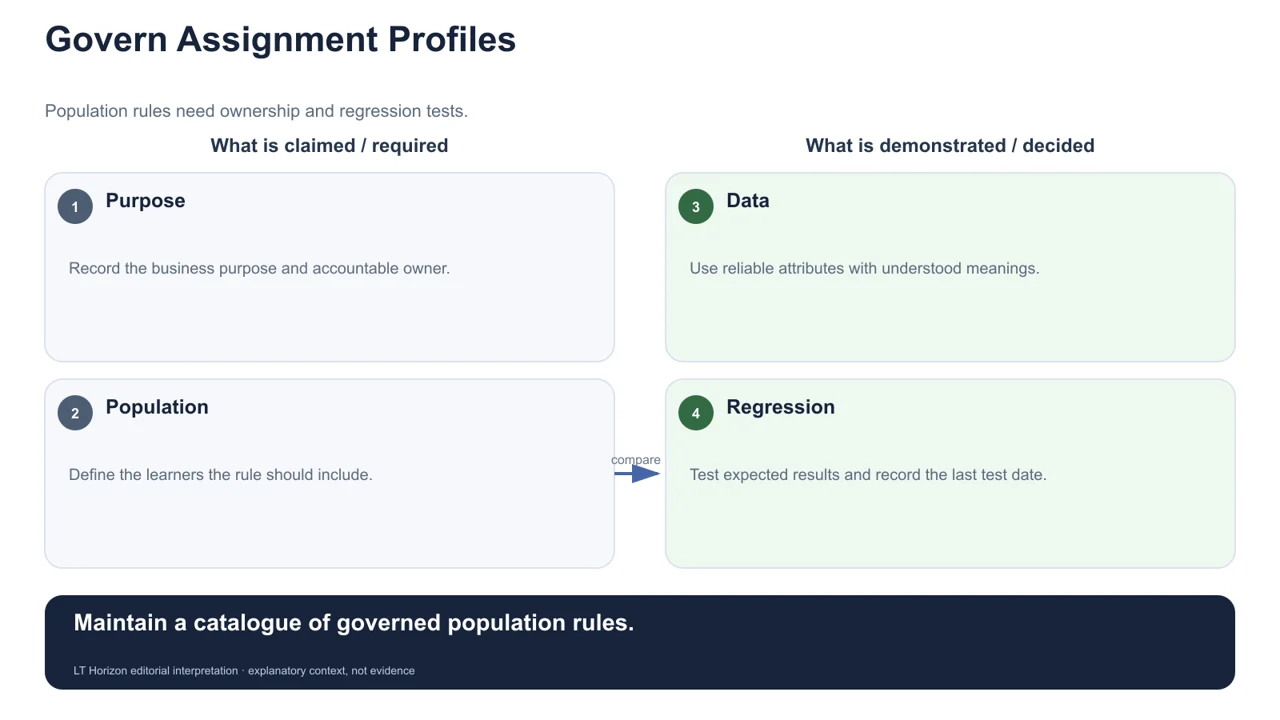
LT Horizon generated editorial illustration · not evidenceImage provenanceLT Horizon owner-supplied editorial assetView diagram at full size
Read diagram text
Keep roadmap plans separate from tenant evidence. Roadmap: Record the planned feature and its stated availability. Preview: Check configuration and behaviour in your tenant. Dependencies: Identify access, data and implementation requirements. Decision: Plan adoption only around behaviour you have verified.
A mapping is a data contract
SAP documents configuring field mappings before Platform-to-Learning synchronisation. The mapping relates a source attribute to a Learning field, with the associated configuration and scheduling determining how the data arrives.
A technically successful transfer says that processing occurred. It does not establish that the value has the right meaning for Learning. An organisation name, a stable identifier and the reference data expected by the receiving field can have different roles in that interpretation.
Why durable identifiers matter
SAP's cited organisation-mapping example uses a durable identifier in Platform custom data for Learning ORG_ID. It explains the principle that division or department names can change while downstream learning controls still need a stable relationship.
The support incident provides a different kind of evidence: a department or organisation change was exported and processed, but did not update the Learning user because the required connector organisation-domain configuration was missing. This is a documented failure mode, not evidence of its prevalence.
Mapping affects more than the load
Learning user attributes can drive assignments and reporting. A mapping decision therefore influences the population selected later, even when no assignment-profile configuration has changed.
The sources support a specific translation and reference-data problem. They do not prescribe one mapping for all tenants or prove that every population error has a connector cause. The design guidance below follows the data from its source meaning to its downstream Learning use, rather than treating field mapping as a one-time technical exercise.
How to read this briefCheck the sources to see what is documented. Our recommendation explains what that means for your decision. Proof patterns add specific design or implementation examples and explain their limits.
LT Horizon DECISION BRIEF
Answer
Start with the Learning decisions each field must support, then map only controlled Platform attributes with an identified owner, transformation rule and reconciliation method.
Who should care
Learning implementation consultants, integration leads, HR data owners and administrators responsible for Assignment Profiles and reporting.
Recommended action
PLAN — create a signed-off field mapping matrix before connector configuration and link each mapped attribute to its downstream use.
LT Horizon interpretation · Evidence confidence C
What changed
No availability change is asserted. LT Horizon verified SAP’s documented requirement to configure Platform-to-Learning field mappings before synchronisation.
Why it matters
A successful load can still produce incorrect assignments if the values are inconsistent or the mapping rules are wrong.
Use cases & proof
Where this holds up in practice
These examples show how a specific claim is supported by documentation or an implementation. Read their limits before applying them to your own environment.
An organisation uses Platform workforce attributes to maintain Learning user organisation values that are subsequently used to drive assignment populations and reporting.
Architecture pattern
Platform workforce attributes and durable organisation identifier → User Connector - SAP SuccessFactors field mapping → Learning ORG_ID → Assignment Profiles, reporting and learner population controls.
Observed / documented outcome
SAP documents both the durable ORG_ID mapping pattern and an operational support case where a workforce organisation change was processed but did not update the Learning user record because required connector organisation-domain configuration was missing.
What this proves
Field mapping and connector configuration can determine whether workforce changes reach the Learning user model correctly. Because organisation attributes are used to drive Learning populations, mapping design is an operational control rather than a simple technical translation.
What it does not prove
It does not prove that every learning-assignment error is caused by User Connector mapping, that every tenant should use the same organisation model, or that the documented support incident is common across the customer base.
Apply with these constraints
Confirm the authoritative attribute, durable identifier, Learning reference data, organisation-domain behaviour, one-to-one mapping constraints, copy-field requirements, source ownership, connector schedule and regression tests before relying on mapped values for assignments.
Last checked 18 Sept 2026 · Reviewed before publication.
Proof pattern · Evidence C
Workday as a workforce source with SAP SuccessFactors Learning
Scenario
An organisation retains Workday as a workforce system while using SAP SuccessFactors learning technology in a mixed enterprise architecture.
Architecture pattern
Workday and internal applications → governed workforce integration → SuccessFactors user/platform layer → Learning; authentication and identity controls remain separate design decisions.
Observed / documented outcome
A published implementation case study documents inbound integrations from Workday and internal applications as part of a SuccessFactors learning management system migration involving more than three million learning-history records.
What this proves
Employee Central is not universally required to be the authoritative workforce system for an organisation using SuccessFactors Learning. A third-party HR system can participate in a governed SuccessFactors Learning architecture.
What it does not prove
It does not prove that Workday connects directly to Learning without the SuccessFactors platform/user layer; it does not prove every tenant, entitlement or integration design is supported; and it does not establish adoption or maturity across the market.
Apply with these constraints
Confirm commercial entitlement, SuccessFactors platform user representation, the supported integration mechanism, identifiers, joiner/mover/leaver ownership, connector timing and authentication for the specific tenant.
Last checked 18 Sept 2026 · Reviewed before publication.
Implementation implications
Prerequisites
A defined source data dictionary, ownership for each attribute, agreed code transformations, test populations and a method for handling blanks, defaults and retired values.
Architecture implications
Field mapping is a contract between Platform data and the Learning data model. Downstream assignments and reports inherit its quality.
Risks
Over-mapping, uncontrolled free text, silent truncation, inconsistent codes and using attributes whose business ownership is unclear.
Testing implications
Test representative and adverse values, nulls, code changes, effective-dated changes, inactive users and the impact on existing Assignment Profile populations.
Source register
What the evidence establishes
Dual LMS migration with inbound Workday integrations
GP Strategies describes a migration involving SAP SuccessFactors learning technology, inbound Workday data and historical learning records. This implementation example shows that the HR data source and learning platform can differ; it does not establish a standard integration for every customer.
Availability: Observed implementation case study; does not establish a universal supported integration pattern.
SAP describes SuccessFactors Learning as a standalone product or part of its human capital management suite. This product description does not, by itself, establish that every implementation can dispense with platform, identity or data-provisioning dependencies.
SAP requires Platform fields to be mapped to Learning before User Connector – SAP SuccessFactors synchronises users. The documentation also says connector mappings and the user update event bus should agree when both update the same users.
Publication review is recorded in the evidence and correction history. Images illustrate the article; they are not evidence.
History and corrections
Article body revision 1 · added 09 Oct 2026. Explanatory text added to the published evidence snapshot; evidence confidence, availability and source verification dates are unchanged.
Published revisions are retained. Update dates change only after a change to the content or evidence.
Correction: Wording reviewed for clarity. The evidence grade and source verification dates are unchanged. · 30 Sept 2026
Keep a clearer view of learning technology.
Get occasional email updates when LT Horizon publishes new Intelligence and Horizon articles. Free to read, with no account required.
Our practical newsletter format brings one question, one idea and one exercise, alongside selected source-linked articles. Editions follow useful reviewed evidence.