Workday Learning powered by Sana: what should customers assess before changing their stack?
Workday Learning powered by Sana brings AI tutoring, authoring and search into a learning proposition connected to Workday people and skills data. Assessing whether it replaces other tools starts with understanding those responsibilities, rather than counting overlapping feature names.
Evidence CDecision horizon NowUpdated 13 Oct 2026
Editorial context for Workday Learning powered by Sana: what should customers assess before changing their stack?
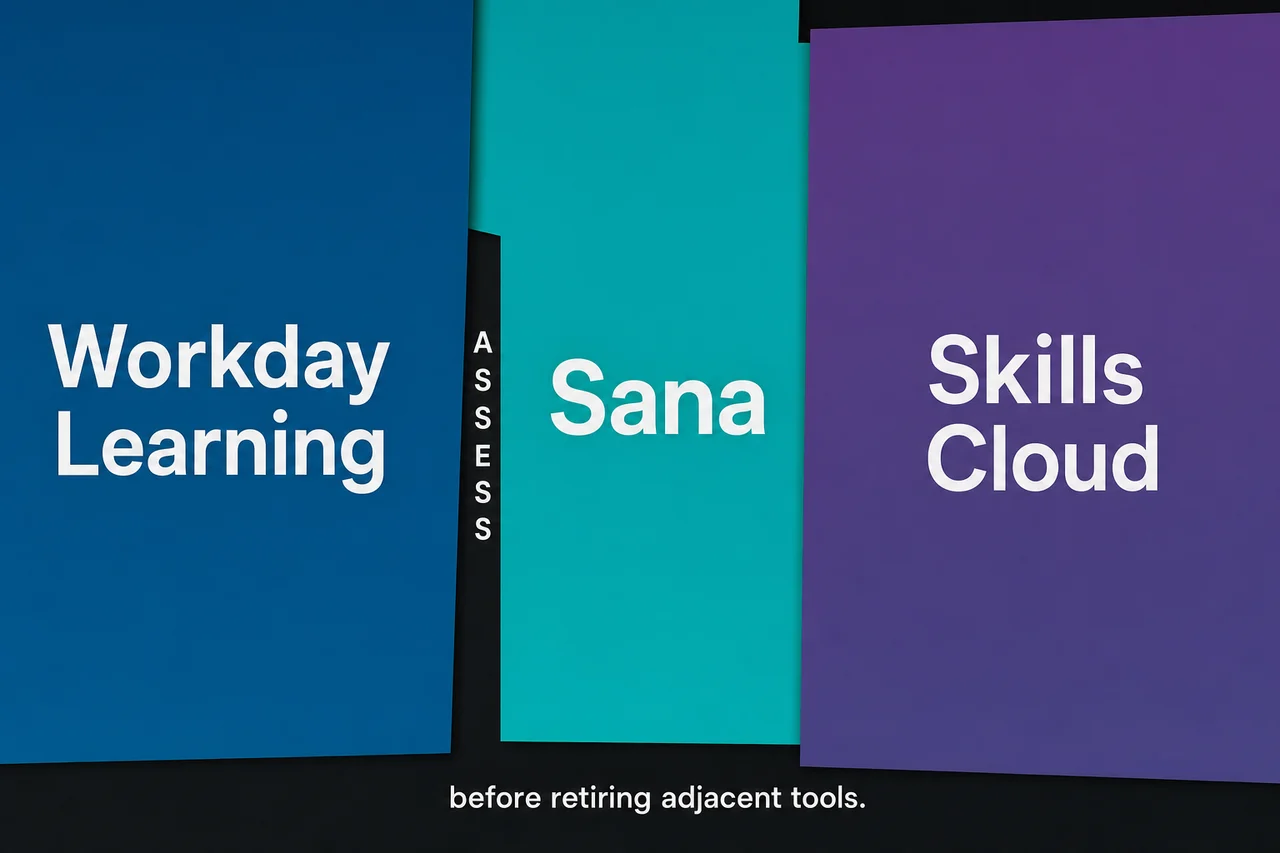
LT Horizon generated editorial illustration · not evidenceImage provenanceLT Horizon Visual Editor v2 · GPT-Image-2 generated editorial illustration; never evidence.
A combined learning proposition
Workday's general-availability announcement describes interactive course creation, personalised learning, smart search, AI tutoring and automated assignments or campaigns for Workday HCM customers. The learner-facing experience and the administrative work sit within a broader people-data context.
That context is significant. Role, organisation, location and skills information can inform which learning is relevant to someone. An experience that appears personalised is therefore connected to both the content available and the workforce information used to interpret the learner's situation.
Similar features can perform different jobs
An authoring tool helps create and revise learning. A tutor supports interaction during learning. Search helps retrieve useful material, while a learning experience platform may organise discovery across several sources. Learning administration manages assignments and the records used to monitor completion.
Those jobs may overlap in the combined product, but overlap is not the same as replacement. A tool with a search feature does not automatically reproduce the coverage, permissions or specialist workflows of another search service. The same distinction applies to course creation, tutoring and skills-driven recommendations.
Availability is a starting point for migration
The announcement covers an integrated offering for HCM customers and a standalone Sana Learn option. Some regulated and sovereign environments still rely on existing Workday Learning guidance because Sana components are not yet supported. Confirm the supported environment before treating the announcement as a migration starting point.
This assessment consequently focuses on the boundary between the new proposition and the jobs an organisation already performs. Content, data, access and operating responsibilities explain where consolidation may be possible; a customer-specific comparison is still needed to establish whether an existing tool can be retired without losing a required workflow.
LT Horizon interpretation · illustrative worked example · 10 October 2026
Should the existing authoring tool be retired?
Imagine a Workday customer whose team uses a separate authoring tool and learning experience platform. This hypothetical assessment is not evidence that Sana replaces either product.
Choose one representative course and three learner tasks: find relevant content, ask a question about it, and complete an assigned activity. Include an administrator who revises the content and reviews the outcome.
Compare the existing tools with the proposed configuration using the same materials and permissions. Record migration work, answer quality, specialist authoring requirements and the time needed for human review. Check any requirements that the announcement does not establish.
Decision: Retire a tool only when its required jobs have been demonstrated in the proposed configuration and the migration and operating costs are understood. Feature-name overlap alone is not a business case.
This example applies the reviewed article’s reasoning. It adds no product availability claim, customer evidence or change to the evidence grade.
How to read this briefCheck the sources to see what is documented. Our recommendation explains what that means for your decision. Proof patterns add specific design or implementation examples and explain their limits.
LT Horizon DECISION BRIEF
Answer
Workday announced general availability for human capital management customers, with exceptions for some regulated and sovereign environments. Before retiring a learning experience platform, authoring tool or AI-learning service, test the tasks those tools perform today. Check content migration, permissions, people and skills data, and the quality of tutoring, search and recommendations.
Who should care
Workday human capital management customers, L&D leaders, HRIT, skills owners, enterprise architects and teams carrying overlapping learning experience platform, search, authoring or AI-tutor products.
Recommended action
INVESTIGATE — run a 30-day architecture and overlap assessment before committing to retire adjacent learning tools. Require evidence that the Workday/Sana combination performs the specific jobs those tools currently do.
LT Horizon interpretation · Evidence confidence C
What changed
Workday announced general availability for human capital management customers, with exceptions where Sana components are not yet supported, including some regulated and sovereign environments. The next step is to check migration requirements and test the tasks your existing tools perform.
Why it matters
Workday uses role, skills, organisation and location data to inform learning. Incomplete or incorrect data can affect recommendations. Check the data and compare Sana with the tools you already use.
Implementation implications
Prerequisites
Current-state learning architecture; Skills Cloud maturity; role, organisation and location data quality; approved content inventory; AI-content governance; regional/privacy constraints; contract and renewal dates for overlapping products.
Architecture implications
List which tools handle discovery, authoring, tutoring, skills, assignments and reporting today. Check how Workday Learning, Sana and Skills Cloud would take on those tasks before consolidating tools.
Risks
Teams can overestimate consolidation savings, underestimate migration/change effort, or assume AI outputs are trustworthy because they sit inside the human capital management suite.
Testing implications
Run persona-based tests for tutor grounding, search precision, recommendations, path relevance, content conversion, assignment/campaign automation, permissions and cross-region behaviour.
Source register
What the evidence establishes
Workday Learning, Powered by Sana, Now Generally Available
Workday describes an integrated human capital management learning offering and standalone Sana Learn. Some regulated and sovereign environments still use existing Workday Learning guidance because Sana components are not yet supported.
Availability: Announced for human capital management customers; some regulated and sovereign environments remain outside the supported Sana rollout.
Publication review is recorded in the evidence and correction history. Images illustrate the article; they are not evidence.
History and corrections
Article body revision 2 · added 13 Oct 2026. Reviewed explanation updated for its published evidence snapshot; see the dated corrections below. Evidence confidence and source verification dates are unchanged.
Illustrative worked example added 10 October 2026. Source verification dates and evidence confidence are unchanged.
Availability source note added 11 October 2026 following a fresh review of Workday’s announcement. The original publication’s evidence grade and stored source verification dates are unchanged.
Published revisions are retained. Update dates change only after a change to the content or evidence.
Revision 5 · published 28 Sept 2026 · updated 13 Oct 2026
Revision 6 · published 28 Sept 2026 · updated 13 Oct 2026
Correction: Evidence grade corrected from A to C on 30 September 2026. The cited sources support documented product claims but do not provide independent proof from live implementations. Wording was also reviewed for clarity. Source verification dates are unchanged. · 30 Sept 2026
Correction: Availability wording and article body now include the regulated and sovereign rollout exception. Evidence confidence and earlier source verification dates are unchanged. · 13 Oct 2026
Keep a clearer view of learning technology.
Get occasional email updates when LT Horizon publishes new Intelligence and Horizon articles. Free to read, with no account required.
Our practical newsletter format brings one question, one idea and one exercise, alongside selected source-linked articles. Editions follow useful reviewed evidence.