Talent Intelligence Hub gives SuccessFactors Learning access to shared skill and competency attributes. The integration connects learning objects with a wider talent model, making the meaning of the attributes as important as their technical availability.
Evidence CDecision horizon 12 monthsUpdated 09 Oct 2026Proof patterns 1
Editorial context for What changes when Learning integrates with Talent Intelligence Hub?
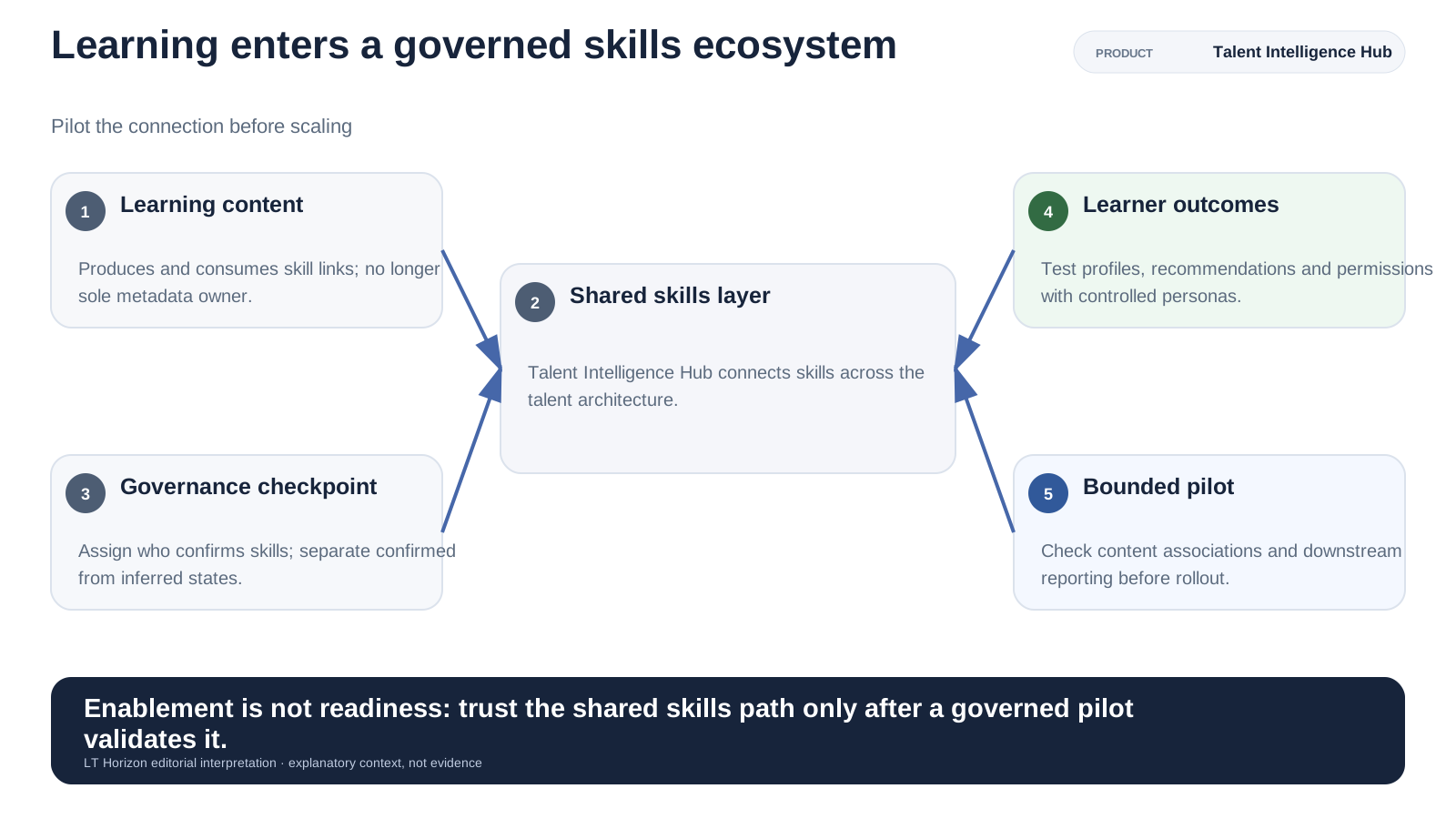
LT Horizon generated editorial illustration · not evidenceImage provenanceLT Horizon deterministic SVG generated from a source-reviewed, catalogue-aware editorial visual contract; explanatory context only, never evidence.View diagram at full size
Read diagram text
A sparse system map shows Learning content connected bidirectionally to a shared Talent Intelligence Hub skills layer. A governance checkpoint distinguishes confirmed from inferred skills and assigns confirmation responsibility. A bounded pilot then tests content associations, learner recommendations, permissions and downstream reporting before wider rollout.
Shared attributes and learning objects
SAP documents using attributes of type skill and competency with Learning items, programs, tasks and objectives. Enabling Talent Intelligence Hub is part of that documented integration, with prerequisite services and synchronisation requirements.
The relationship is not simply a new label on a course. A capability can be associated with content or a learning objective and then participate in wider talent experiences. The same attribute can consequently be relevant to both the learning catalogue and the person's development context.
An enabled connection is not a mature skills model
Technical integration establishes that attributes can be exchanged and used. It does not establish that the organisation's taxonomy is coherent, that every association is accurate or that an inferred skill has been confirmed.
This distinction explains why the source describes prerequisites while the enterprise still has decisions about ownership and data meaning. A shared attribute needs an understood definition and lifecycle if different processes are to interpret it consistently.
What the customer example adds
The cited Grundfos story describes testing Talent Intelligence Hub alongside SuccessFactors Learning and other talent solutions. It discusses refining a skills taxonomy and data model, with early visibility benefits and intended learning recommendations.
That is evidence of a real skills-foundation programme, but the story remains a pilot or early rollout rather than mature enterprise-wide outcome proof. The application guidance below concerns the connection between technical enablement, content associations and trustworthy skills context.
How to read this briefCheck the sources to see what is documented. Our recommendation explains what that means for your decision. Proof patterns add specific design or implementation examples and explain their limits.
LT Horizon DECISION BRIEF
Answer
Talent Intelligence Hub supplies shared skills and competency attributes to Learning. Agree who checks those attributes, maintains the taxonomy and links skills to content and recommendations before enabling them.
Who should care
Learning architects, skills programme leads, talent technology owners, content teams and data-governance leaders.
Recommended action
PILOT — select a bounded skills domain, define governance and test the complete content-to-skill-to-learner experience before scaling.
LT Horizon interpretation · Evidence confidence C
What changed
No new release claim is made. LT Horizon verified the documented dependency for using skill and competency attributes across selected Learning objects.
Why it matters
Skills functionality becomes part of a wider talent architecture. Weak taxonomy ownership or ungoverned inference can reduce trust in recommendations and reporting.
Use cases & proof
Where this holds up in practice
These examples show how a specific claim is supported by documentation or an implementation. Read their limits before applying them to your own environment.
Proof pattern · Evidence C
Talent Intelligence Hub connects governed skills to learning decisions
Scenario
An organisation uses Talent Intelligence Hub as a shared skills foundation and SuccessFactors Learning as one of the experiences that consumes governed skill and competency information.
Architecture pattern
Governed skills taxonomy in Talent Intelligence Hub → synchronized skill and competency attributes → Learning items, programs, tasks and objectives → skills-informed learning and development experiences.
Observed / documented outcome
SAP documents that Talent Intelligence Hub must be enabled to use skill and competency attributes across selected Learning objects. Grundfos separately reports a real pilot in which it is building a centralized skills foundation alongside SuccessFactors Learning, refining its taxonomy and data model, and seeing early positive results in team-level skills visibility while preparing skills-informed learning and development recommendations.
What this proves
Talent Intelligence Hub is a real upstream dependency when SuccessFactors Learning uses shared skill and competency attributes, so skills taxonomy quality and governance become part of Learning architecture rather than a separate talent-only concern. A named customer programme shows that organisations are using this shared skills-foundation approach in practice.
What it does not prove
It does not prove that Grundfos has completed an enterprise-wide rollout, that skills-based recommendations have produced quantified learning ROI, that every Learning object or tenant should use the same taxonomy, or that enabling Talent Intelligence Hub by itself creates a mature skills operating model.
Apply with these constraints
Confirm Talent Intelligence Hub prerequisites and licensing, taxonomy ownership, locale alignment, synchronization jobs, skill lifecycle governance, content tagging, confirmation or inference rules, permissions, data stewardship and measurable learning outcomes before scaling.
Learning shares skills and competency data with other talent processes. Agree which system maintains each attribute and how changes reach Learning.
Risks
Duplicate or low-quality skills, unclear confirmation responsibility, inconsistent content tagging and treating enablement as proof of organisational readiness.
Testing implications
Test skill availability, content associations, confirmed versus inferred states, recommendations, permissions and downstream reporting with controlled personas.
Source register
What the evidence establishes
Grundfos pilots Talent Intelligence Hub as a shared skills foundation alongside SuccessFactors Learning
Public summary awaiting review. See the original source.
Publication review is recorded in the evidence and correction history. Images illustrate the article; they are not evidence.
History and corrections
Article body revision 1 · added 09 Oct 2026. Explanatory text added to the published evidence snapshot; evidence confidence, availability and source verification dates are unchanged.
Published revisions are retained. Update dates change only after a change to the content or evidence.
Correction: Wording reviewed for clarity. The evidence grade and source verification dates are unchanged. · 30 Sept 2026
Keep a clearer view of learning technology.
Get occasional email updates when LT Horizon publishes new Intelligence and Horizon articles. Free to read, with no account required.
Our practical newsletter format brings one question, one idea and one exercise, alongside selected source-linked articles. Editions follow useful reviewed evidence.