Oracle agentic learning: what changed from 26C to 26D?
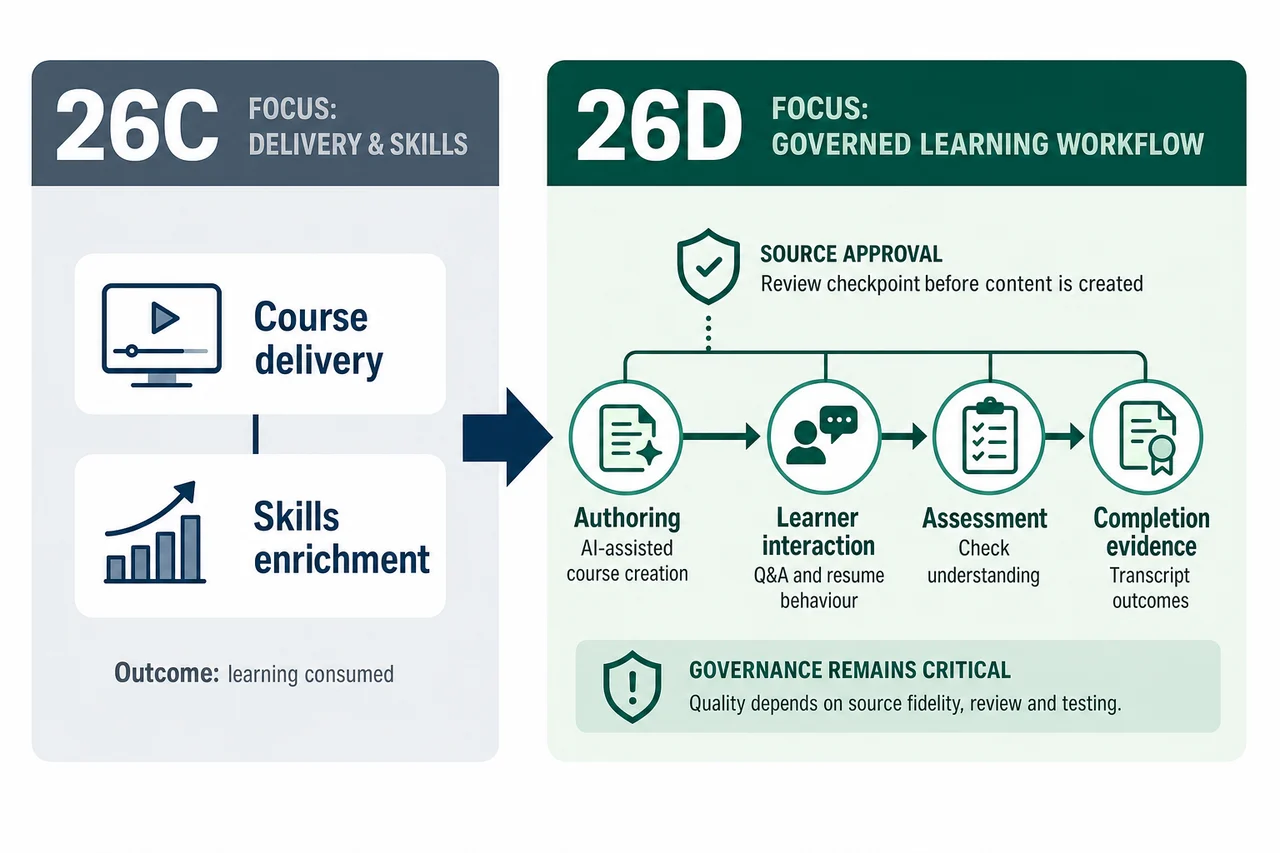
Oracle's agentic learning development connects course creation with an interactive delivery experience. The 26D documentation makes that connection more explicit through separate designer and player workspaces, building on the agentic-course direction described in 26C.
Evidence CDecision horizon Next releaseUpdated 10 Oct 2026
Editorial context for Oracle agentic learning: what changed from 26C to 26D?
LT Horizon generated editorial illustration · not evidenceImage provenanceLT Horizon Visual Editor v2 · GPT-Image-2 generated editorial illustration; never evidence.
What the designer produces
Agentic Course Designer uses approved source materials, including documents, presentations and transcripts, to build and refine a self-paced course. Oracle describes generation of course structure, content, checks for understanding, assessment rules and remediation.
The result is an editable draft. Generation is therefore one stage in an authoring lifecycle, rather than the publication decision itself. The documented workflow includes reviewing, previewing and activating the course. Learning Connect licensing and the relevant authoring access are part of its availability context.
What changes for the learner
Agentic Course Player is the delivery side of that lifecycle. Oracle describes required content, practice, assessments, feedback, remediation and progress through an agentic course, with completion and transcript outcomes.
That is a more specific proposition than a chatbot placed beside an existing course. The player participates in the learning sequence and the treatment of progress. The cited documentation also excludes external labs, live application access and simulations; those should not be assumed to follow from the word agentic.
How the release story fits together
The 26C material establishes the earlier account of curated learning delivered through an AI-agent chat experience, with adaptation, understanding checks and remediation. The 26D designer and player material describes a fuller create, refine, activate and deliver lifecycle.
The sources establish documented capabilities and prerequisites, not readiness in every tenant or improved learning outcomes. Active-course editing can also affect learner attempts. This makes source quality, publication control and learner state part of the explanation of the product, before the pilot and testing advice below is applied.
LT Horizon interpretation · illustrative worked example · 10 October 2026
A controlled pilot for one learning topic
Imagine a team piloting a course based on an approved internal procedure. This is a proposed test design, not a measured Oracle customer outcome.
Have the content owner approve the source first. Review the generated structure, explanations, questions and assessment rules before activating a pilot course. Record review effort as well as authoring effort.
Test an accurate answer, an incorrect answer, a question outside the material, a resumed attempt and a completed attempt. Check what reaches the learner record, and test the effects of a permitted course edit on an in-progress attempt. Confirm release access and licensing first.
Decision: A faster draft is useful only if the reviewed learning experience and completion records remain reliable. Use the pilot results to decide whether to expand, revise or stop.
This example applies the reviewed article’s reasoning. It adds no product availability claim, customer evidence or change to the evidence grade.
How to read this briefCheck the sources to see what is documented. Our recommendation explains what that means for your decision. Proof patterns add specific design or implementation examples and explain their limits.
LT Horizon DECISION BRIEF
Answer
Oracle’s 26D documentation describes Agentic Course Designer for building editable courses from approved source material, with knowledge checks and assessment rules. Agentic Course Player handles progression, practice, feedback and completion. Confirm release access and Learning Connect licensing, then test source accuracy, review effort and learner records.
Who should care
Oracle Learning customers, learning designers, HRIT, compliance owners, AI governance teams and organisations evaluating whether agentic learning can replace parts of traditional course-authoring workflows.
Recommended action
PLAN — create a controlled pilot using one well-governed course domain. Measure authoring effort, review effort, learner outcomes and defects before scaling agentic-course production.
LT Horizon interpretation · Evidence confidence C
What changed
Oracle documents 26D workspaces for creating, editing, previewing and activating agentic courses, and for delivering them to learners.
Why it matters
The approved sources shape the course, questions and feedback. Review those sources first, then check the generated content and assessment before activation.
Implementation implications
Prerequisites
Learning Connect licensing, approved source materials, author privileges, Agent Studio access, course governance and a defined review/activation process.
Architecture implications
Agent Studio, Learning authoring, course delivery, assessment and transcript outcomes become more tightly connected. Organisations need clear ownership for approved source material, generated content, activation and change control.
Risks
Weak source material can be amplified into polished but unreliable instruction; editing active courses can affect in-progress attempts; generated assessments can create false confidence if not reviewed.
Testing implications
Test source fidelity, structure generation, assessment quality, remediation logic, learner Q&A boundaries, resume behaviour, transcript completion, certificates and the impact of edits on active attempts.
Source register
What the evidence establishes
Agentic Course Designer
Oracle documents a 26D Agentic Course Designer that creates and refines draft self-paced courses from approved PDF, PowerPoint, document and transcript sources, including structure, content, checks, assessment rules and remediation.
Availability: Oracle human capital management 26D; Learning Connect SKU required.
Oracle documents a learner experience for required content, practice, assessments, remediation, progress, completion and transcript outcomes in agentic courses.
Availability: Oracle human capital management 26D.
Oracle says agentic courses use curated learning materials, adapt to learner pace and needs, support checks for understanding and remediation, and are delivered through an AI agent chat experience.
Availability: Oracle human capital management Update 26C.
Oracle lists AI capabilities across Dynamic Skills and Learning, including Learning Tutor, learning assistants, agentic courses and manager learning workspace enhancements.
Availability: Current Oracle AI feature catalogue.
Publication review is recorded in the evidence and correction history. Images illustrate the article; they are not evidence.
History and corrections
Article body revision 1 · added 09 Oct 2026. Explanatory text added to the published evidence snapshot; evidence confidence, availability and source verification dates are unchanged.
Illustrative worked example added 10 October 2026. Source verification dates and evidence confidence are unchanged.
Published revisions are retained. Update dates change only after a change to the content or evidence.
Correction: Evidence grade corrected from A to C on 30 September 2026. The cited sources support documented product claims but do not provide independent proof from live implementations. Wording was also reviewed for clarity. Source verification dates are unchanged. · 30 Sept 2026
Keep a clearer view of learning technology.
Get occasional email updates when LT Horizon publishes new Intelligence and Horizon articles. Free to read, with no account required.
Our practical newsletter format brings one question, one idea and one exercise, alongside selected source-linked articles. Editions follow useful reviewed evidence.