User Connector – SAP SuccessFactors synchronises user attributes from SuccessFactors Platform into Learning. Its role is to keep the Learning user model aligned with the information used for assignments, search and reporting.
Evidence CDecision horizon Not specifiedUpdated 09 Oct 2026
Editorial context for What does User Connector – SF do?
LT Horizon generated editorial illustration · not evidenceImage provenanceLT Horizon deterministic SVG generated from a source-reviewed, catalogue-aware editorial visual contract; explanatory context only, never evidence.View diagram at full size
Read diagram text
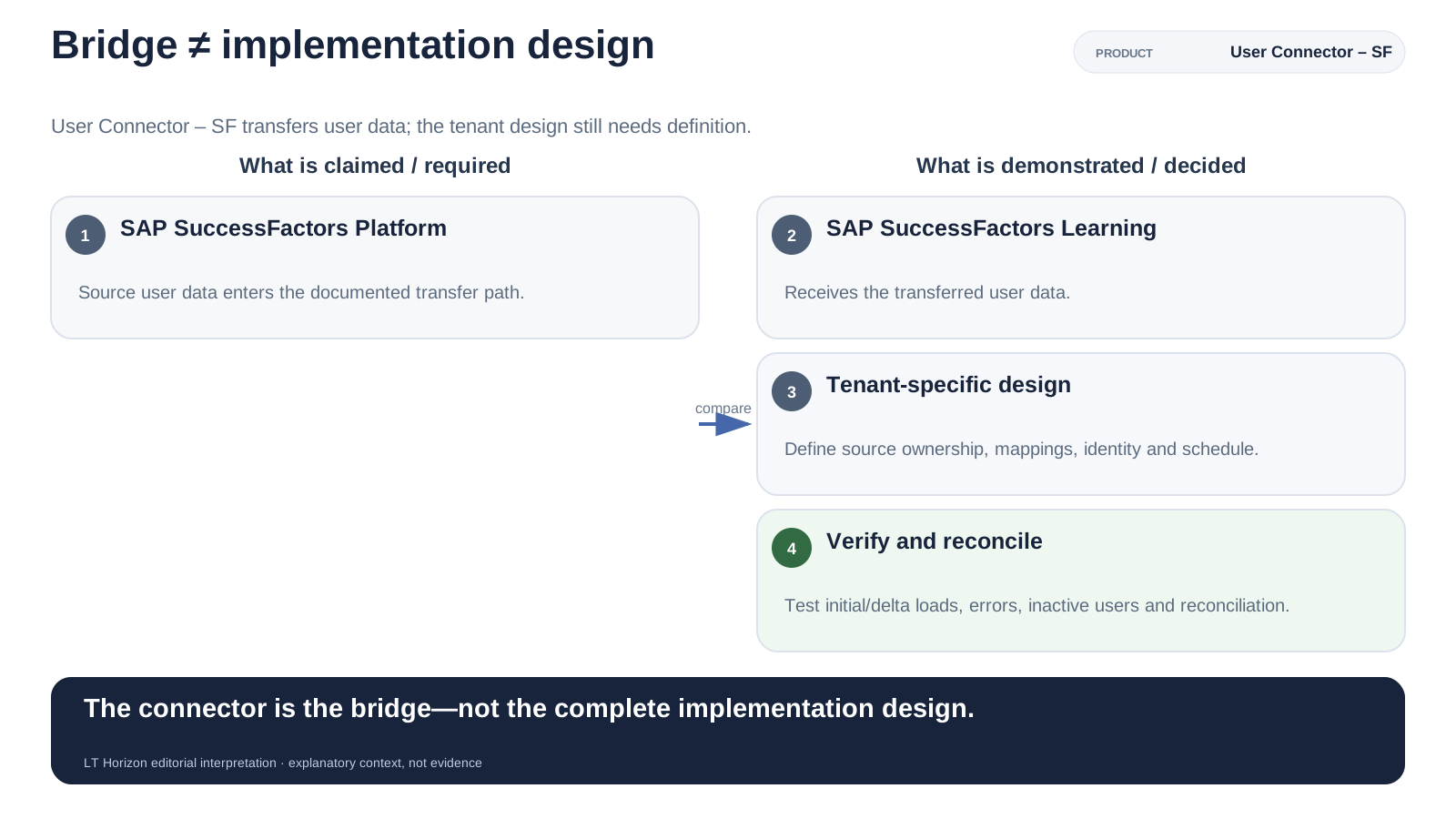
Comparison diagram contrasting the documented role of User Connector – SF with tenant-specific implementation work. User data flows from SAP SuccessFactors Platform through User Connector – SF into SAP SuccessFactors Learning, while ownership, mappings, identity, scheduling and reconciliation remain to be defined and tested.
What crosses the boundary
SAP documents Platform as the user-data system of record within this connector pattern. The connector brings relevant attributes into Learning, where the user record has a learning-specific purpose.
That direction matters. Describing Platform-to-Learning synchronisation does not, by itself, establish how Platform receives data from another workforce system. It also does not make the connector equivalent to authentication or a complete enterprise identity architecture.
Why scheduled updates affect learning
The documentation explains that Learning data becomes stale when the connector is not scheduled. Attribute-based assignments then depend on values that may no longer represent the person's current circumstances.
For example, a workforce change can alter the location or organisation relevant to learning eligibility. The source change has to be reflected in Learning before downstream population logic can use it. This explains the connector's business role without assuming a particular customer's schedule or field transformation.
Successful processing is one part of the result
The intended end state is an appropriately identified user with current attributes, not merely a completed load. Mapping, identifier treatment and reconciliation explain whether the receiving Learning record means what the source intended.
The cited source establishes the connector's purpose and the importance of synchronisation. The implementation guidance below addresses the surrounding design questions that documentation alone does not resolve: authoritative ownership, processing cadence, exceptions and the comparison between source and Learning results.
How to read this briefCheck the sources to see what is documented. Our recommendation explains what that means for your decision. Proof patterns add specific design or implementation examples and explain their limits.
LT Horizon DECISION BRIEF
Answer
SAP documents User Connector – SAP SuccessFactors as the mechanism for bringing user data from SAP SuccessFactors Platform into SAP SuccessFactors Learning.
Who should care
SAP SuccessFactors Learning owners, implementation consultants, solution architects and HRIT leads.
Recommended action
INVESTIGATE — verify the SAP source, then document tenant-specific ownership, mappings, cadence and exception handling.
LT Horizon interpretation · Evidence confidence C
Why it matters
Connector purpose is only the starting point. Implementation decisions still depend on authoritative data, field mappings, scheduling, identity and reconciliation.
Implementation implications
Prerequisites
Confirm the authoritative workforce source, the user attributes available in SAP SuccessFactors Platform and the tenant-specific integration design.
Architecture implications
Separate the documented connector role from upstream source-of-record, identity and downstream assignment decisions.
Risks
Treating product documentation as a complete implementation design can obscure mapping gaps, timing dependencies and ownership boundaries.
Testing implications
Test initial and delta loads, field transformations, inactive users, error handling and reconciliation in the target landscape.
Source register
What the evidence establishes
SAP Help: Purpose of User Connector – SF
Public summary awaiting review. See the original source.
Publication review is recorded in the evidence and correction history. Images illustrate the article; they are not evidence.
History and corrections
Article body revision 1 · added 09 Oct 2026. Explanatory text added to the published evidence snapshot; evidence confidence, availability and source verification dates are unchanged.
Published revisions are retained. Update dates change only after a change to the content or evidence.
Get occasional email updates when LT Horizon publishes new Intelligence and Horizon articles. Free to read, with no account required.
Our practical newsletter format brings one question, one idea and one exercise, alongside selected source-linked articles. Editions follow useful reviewed evidence.