When does LTI 1.3 matter in an enterprise learning stack?
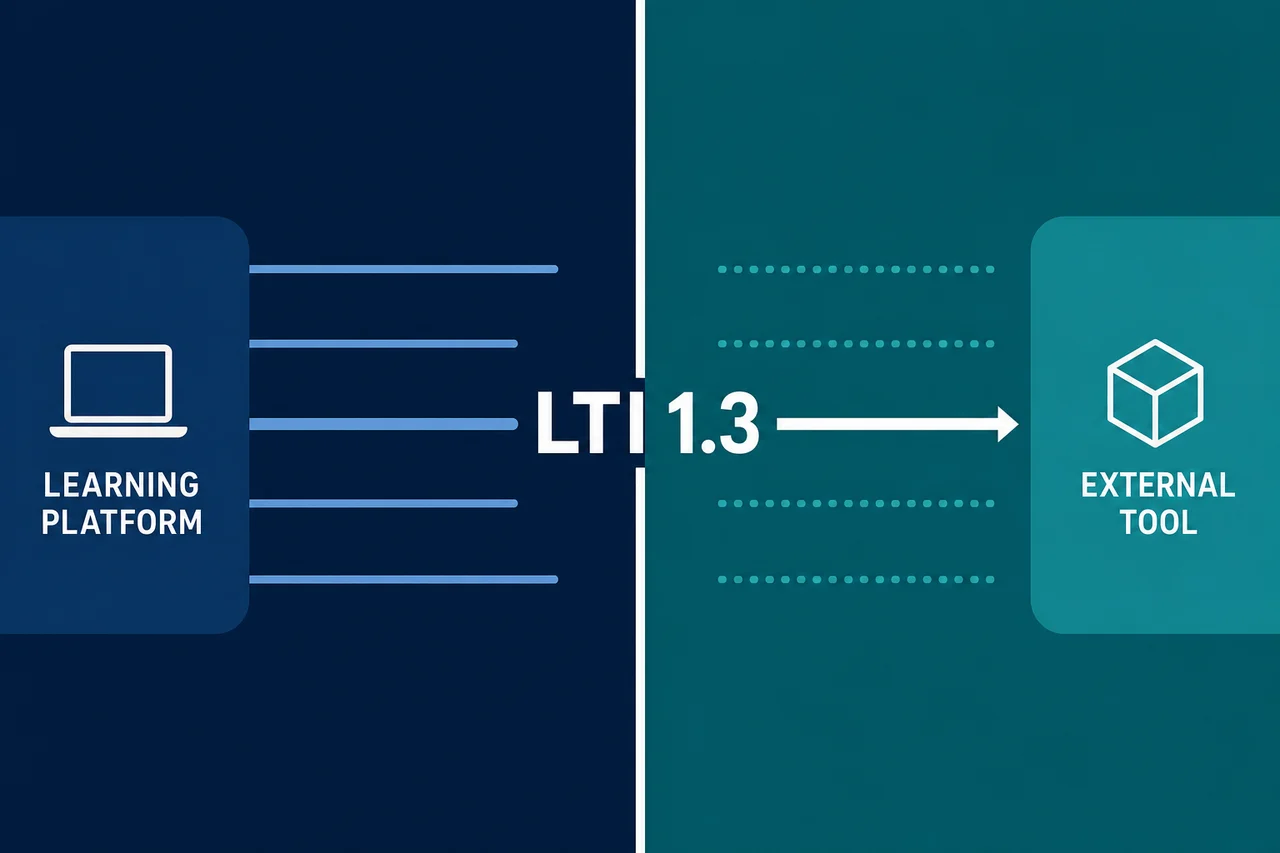
LTI 1.3 connects a learning platform with an external learning tool through a standard launch and context exchange. It is most useful to understand it as one integration boundary within a larger learner journey.
Evidence CDecision horizon NowUpdated 09 Oct 2026Proof patterns 1
Editorial context for When does LTI 1.3 matter in an enterprise learning stack?
LT Horizon generated editorial illustration · not evidenceImage provenanceLT Horizon Visual Editor v2 · GPT-Image-2 generated editorial illustration; never evidence.
Platform, tool and launch
The platform is the environment from which the learner starts. The tool provides the external activity or content. The LTI launch passes an agreed context between them using the standard's security model, rather than requiring every provider to invent a different launch mechanism.
1EdTech's conformance material documents the OIDC, JWT, key and service configuration used in LTI 1.3 certification. Those details establish the protocol boundary. They do not, by themselves, determine the organisation's full identity or learner-data lifecycle.
Core launch and additional services
LTI Advantage services cover exchanges beyond the core launch. Deep Linking supports selecting and placing tool content; Names and Role Provisioning and Assignment and Grade Services address additional participant-context and outcome exchanges within their defined scope.
A product's claim to support LTI 1.3 should therefore be read alongside the particular services it implements. A working launch is not evidence that every desired roster or result flow is available. The cited 1EdTech guidance treats certification of these components separately.
Where the standard stops
The surrounding operation still includes permission decisions, support ownership, key maintenance and behaviour when a tool or user becomes unavailable. Other provisioning or data exchanges may require separate arrangements.
This explains both the attraction and the limit of standards-based integration. LTI can provide a consistent technical boundary while leaving meaningful business responsibilities outside it. The architecture guidance below concerns those remaining responsibilities as well as the standardised exchange.
How to read this briefCheck the sources to see what is documented. Our recommendation explains what that means for your decision. Proof patterns add specific design or implementation examples and explain their limits.
LT Horizon DECISION BRIEF
Answer
LTI 1.3 supports launching external learning tools and exchanging context. Confirm the services your workflow needs, then test identity, permissions, data sharing and support responsibilities.
Who should care
Learning architects, learning management system owners, security teams, procurement teams, platform vendors and integration leads.
Recommended action
INVESTIGATE — include standards support and conformance evidence in the integration design, then test the complete business workflow rather than only a successful launch.
LT Horizon interpretation · Evidence confidence C
What changed
No new standard release is asserted. This is a foundational decision brief on where LTI belongs in an enterprise architecture.
Why it matters
A standard can reduce custom integration effort while still leaving important organisational questions unresolved. Buyers should distinguish protocol support from a complete operating integration.
Use cases & proof
Where this holds up in practice
These examples show how a specific claim is supported by documentation or an implementation. Read their limits before applying them to your own environment.
Proof pattern · Evidence C
LTI 1.3 conformance narrows integration risk but does not remove deployment design
Scenario
An organisation evaluates or procures an external learning tool that claims LTI 1.3 or LTI Advantage support and needs to determine whether the target workflow will actually operate securely in its learning environment.
Architecture pattern
Learning platform ↔ OIDC/JWT trust and keys ↔ LTI tool launch; optional Deep Linking, Names and Role Provisioning and Assignment and Grade services sit on top, while platform-specific registration, scopes, privacy and operational support remain part of the deployment.
Observed / documented outcome
1EdTech defines LTI 1.3 Core and the LTI Advantage services separately, provides conformance testing for the applicable components and publishes procurement language asking buyers to verify exact versions, services and current certification. Canvas implementation documentation shows that a real LTI 1.3 deployment still requires client and deployment registration, OIDC and key configuration, scopes, placements and privacy choices.
What this proves
A standards claim should be decomposed into exact version, services, certification state and target workflow. Certification meaningfully reduces protocol-conformance uncertainty, but a buyer still needs to validate deployment configuration, permissions, privacy, failure handling and any responsibilities outside the standard.
What it does not prove
It does not prove that every certified pair will require zero vendor-specific configuration, that all LTI 1.3 products support all LTI Advantage services, that certification covers availability or support quality, or that LTI replaces provisioning, reporting, data-governance or API requirements outside the selected services.
Apply with these constraints
Specify the target launch and data workflows, required Advantage services, current certification, identity and privacy requirements, keys and rotation, service scopes, roles, disabled-user behaviour, error handling, support ownership, version lifecycle and any non-LTI interfaces before contract signature or production rollout.
Last checked 18 Sept 2026 · Reviewed before publication.
Implementation implications
Prerequisites
Confirm platform and tool LTI support, required services, trust and key-management model, user-context requirements, data boundaries, launch flows, support ownership and lifecycle events.
Architecture implications
Use LTI as an integration boundary where appropriate, but document which data and responsibilities remain outside the standard and require separate APIs, provisioning or operational processes.
Risks
Assuming standards support equals plug-and-play interoperability, oversharing user context, incomplete role mapping, weak key rotation, poor error handling and no ownership for external-tool availability.
Testing implications
Test launches, roles, deep links where used, grades or outcomes where used, key rotation, disabled users, permission boundaries, failure states and vendor version compatibility.
Source register
What the evidence establishes
When does LTI 1.3 matter in an enterprise learning stack? — 1EdTech evidence
Public summary awaiting review. See the original source.
Publication review is recorded in the evidence and correction history. Images illustrate the article; they are not evidence.
History and corrections
Article body revision 1 · added 09 Oct 2026. Explanatory text added to the published evidence snapshot; evidence confidence, availability and source verification dates are unchanged.
Published revisions are retained. Update dates change only after a change to the content or evidence.
Correction: Evidence grade corrected from B to C. The cited documentation or standard supports the guidance; independent implementation proof has not been reviewed. Wording reviewed for clarity; source verification dates are unchanged. · 30 Sept 2026
Keep a clearer view of learning technology.
Get occasional email updates when LT Horizon publishes new Intelligence and Horizon articles. Free to read, with no account required.
Our practical newsletter format brings one question, one idea and one exercise, alongside selected source-linked articles. Editions follow useful reviewed evidence.