Why is skills intelligence becoming part of the learning stack?
Skills intelligence is becoming part of learning because platforms increasingly use information about capability to decide what content to surface and which development opportunities are relevant. It connects learning to a wider talent-data model.
Evidence CDecision horizon 6 monthsUpdated 09 Oct 2026
Editorial context for Why is skills intelligence becoming part of the learning stack?
LT Horizon generated editorial illustration · not evidenceImage provenanceLT Horizon Visual Editor v2 · GPT-Image-2 generated editorial illustration; never evidence.
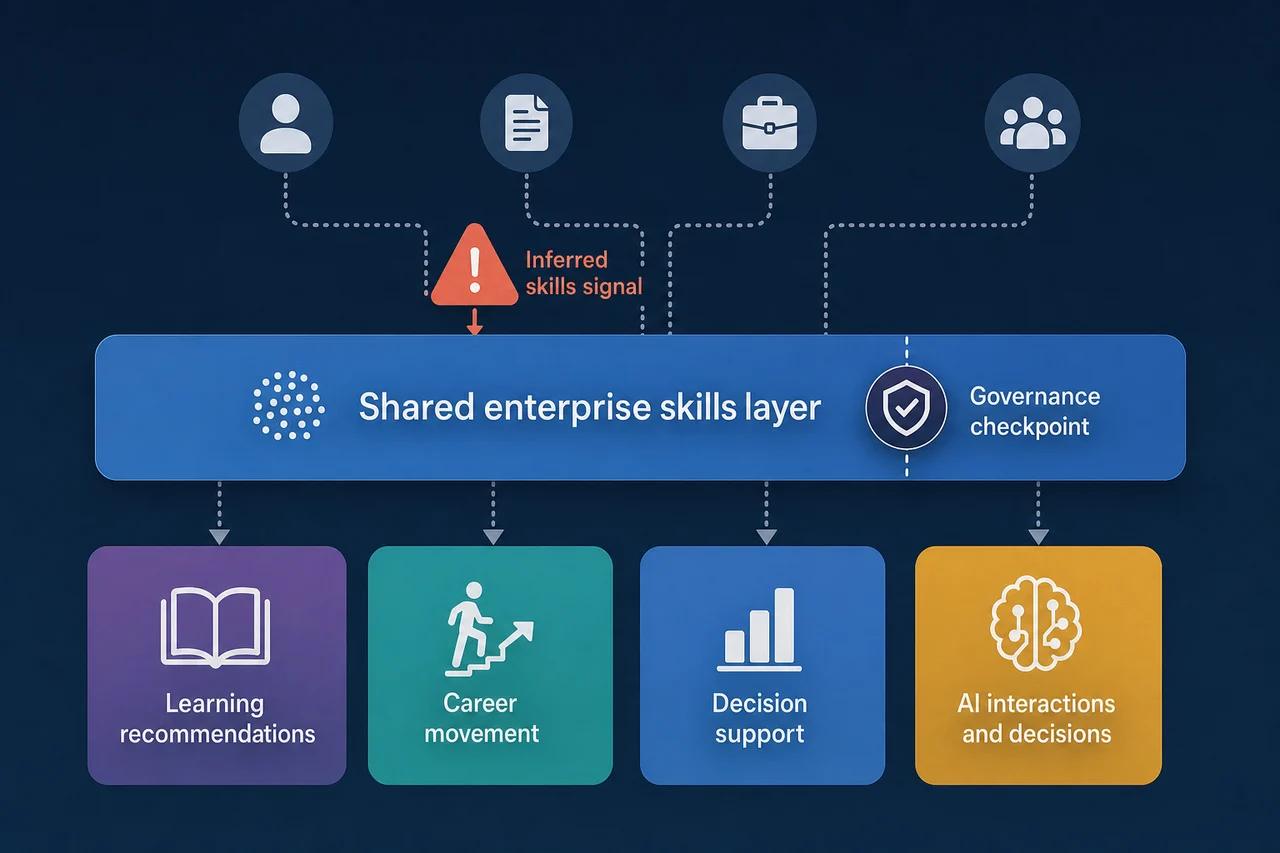
The layer between people, roles and content
Workday describes Skills Cloud as a foundation for analysing relationships between skills and supporting personalised learning. Oracle describes Dynamic Skills as a changing skills layer across people, jobs and talent processes. 360Learning's upskilling material uses skill-gap information to target learning.
These propositions share an underlying relationship: a person or role is associated with skills, and learning is associated with the capabilities it may help develop. The quality of those associations affects the experience that appears at the learner-facing end of the system.
Inference is different from confirmation
An inferred skill is a system's conclusion from available information. A confirmed or assessed skill has a different evidential basis. A course tagged with a skill establishes a content association; completing that course does not, by itself, demonstrate the same level of proficiency as performing the work.
This distinction helps explain why skills data requires more than a large vocabulary. Definitions, relationships, evidence and updates influence what a profile means. The same skill label can otherwise be used with inconsistent expectations across learning and talent processes.
Why a shared layer increases both reach and dependence
When learning, mobility and other talent processes use common skills context, one update may affect several experiences. The benefit described by vendors is more relevant development and a more connected talent picture. The dependency is that weak or stale information can also be propagated more widely.
The cited sources establish these product directions, not universal recommendation accuracy or measured business impact. The governance and testing guidance below concerns the shared data layer that makes those learning experiences possible.
How to read this briefCheck the sources to see what is documented. Our recommendation explains what that means for your decision. Proof patterns add specific design or implementation examples and explain their limits.
LT Horizon DECISION BRIEF
Answer
Workday, Oracle and specialist platforms use skills data in recommendations, content tagging and AI interactions. That makes the quality of skills data a learning-platform concern. Check how skills are inferred, reviewed and linked to content, and who keeps the data up to date.
Who should care
Learning leaders, skills programme owners, talent teams, HRIT architects and organisations implementing AI-driven recommendations or career mobility.
Recommended action
PLAN — establish a skills-governance baseline before expanding AI-driven learning: ownership, source hierarchy, validation, taxonomy change control and success measures.
LT Horizon interpretation · Evidence confidence C
What changed
Workday continues to position Skills Cloud as the skills intelligence foundation for personalised learning; Oracle connects Dynamic Skills with generative suggestions and Learning; specialist vendors such as 360Learning are also using AI to map skills, identify gaps and drive targeted upskilling.
Why it matters
If skills data becomes an input to learning recommendations and AI agents, taxonomy quality directly affects learner experience. Duplicate, stale or weakly evidenced skills can create misleading personalisation at scale.
Implementation implications
Prerequisites
Define ownership for the skills ontology, inference rules, validation, employee/manager edits, content tagging, role mapping and retirement of duplicate or obsolete skills.
Architecture implications
Skills becomes shared infrastructure across learning, talent, recruiting and mobility. Platform decisions should therefore consider how the skills layer is governed and exchanged, not only the learner-facing experience.
Risks
Large ontologies can create a false sense of maturity. AI-generated descriptions or inferred skills may be useful accelerators but still require governance, traceability and clear handling of irreversible or tenant-wide configuration choices.
Testing implications
Test skill inference against known employee and role examples, content tagging accuracy, recommendation quality, duplicate handling, manager/employee validation and downstream effects on learning and opportunity recommendations.
Source register
What the evidence establishes
Workday Skills Cloud
Public summary awaiting review. See the original source.
Publication review is recorded in the evidence and correction history. Images illustrate the article; they are not evidence.
History and corrections
Article body revision 1 · added 09 Oct 2026. Explanatory text added to the published evidence snapshot; evidence confidence, availability and source verification dates are unchanged.
Published revisions are retained. Update dates change only after a change to the content or evidence.
Correction: Evidence grade corrected from A to C on 30 September 2026. The cited sources support documented product claims but do not provide independent proof from live implementations. Wording was also reviewed for clarity. Source verification dates are unchanged. · 30 Sept 2026
Keep a clearer view of learning technology.
Get occasional email updates when LT Horizon publishes new Intelligence and Horizon articles. Free to read, with no account required.
Our practical newsletter format brings one question, one idea and one exercise, alongside selected source-linked articles. Editions follow useful reviewed evidence.